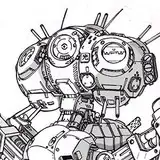
Appendix: An Introductory Monograph on Demonology
Added 2023-09-23 17:00:05 +0000 UTCHello again, everyone! Things are absolutely crazy here on my end, but I can't talk about everything yet. Hopefully good things in store for TWC and my career.
Before this week's content, I want to ask for your algorithmic support. There may be more industry people looking at my work over the coming weeks, and some industry people only care about numbers, so I want to shine up everything. Here are some things you could do:
- If you have been meaning to review/rate any of my books on Amazon, now would be a great time.
- The Weirkey Chronicles has a series page that also accepts separate reviews and could use more.
- If you use Goodreads, my profile could use followers and books can always use ratings/reviews.
- You are already helping a lot by being part of this Patreon. ^-^
I don't mean to stress this too much, and no one should feel obligated, but if you want to give my career a little nudge upward, please consider doing any of the above!
All that said, this week I have another appendix for you. It is another in-world document, trying to balance organizing information the reader already has and giving new hints and lore.
-
An Introductory Monograph on Demonology
by Hebastius from the Academy of Scintillation
Much has been written of demons, given their importance across the Nine Worlds. Your humble scholar may not be the best able to address this topic, but I will attempt to assemble available information in this, my submission to the Academy of Scintillation.
Section 1: The Fundamental Nature of Demonkind
Regrettably I must begin with the least satisfying area of knowledge. So little is known of the fundamental nature of demons that it might be easier to begin by stating what we are certain they are not.
Demons are not native inhabitants of any world, certainly not among the Nine and likelyany other. They do not breed or reproduce, and indeed have no anatomy for such a purpose. Though most will consume humans or animals, they do not appear to require this or any form of sustenance. Perhaps notably, no demon in any record available to me has ever been observed to drink water or any other substance.
Demons have been held in captivity for periods of greater than a decade with no sign of starvation. They can temporarily exhaust themselves in combat but will recover without any inputs, including theorized sources such as air or sunlight. During this period they alternated between attacking their bonds and recuperating, without any variation from this pattern. There are some claims that higher stage demons display more intelligent behavior in captivity, but I have not personally confirmed this. Certainly it seems probablethat different demon breeds would behave differently (see Section 2).
Anatomical study of demonkind has delivered inconsistent results. Some consist of only flesh and sinew, similar to meat-based humans on other worlds, some appear to be controlled matter, similar to Mundhin. Others have been found with elaborate organ systems that resemble no known creatures. None have been found with functional digestive systems. Curiously, most demons do have weak points comparable to the brain and heart, and some can be suffocated.
Some have theorized that demons are the native inhabitants of the void between worlds, which is a theory that at minimum cannot be disproven. Specialist scholars argue it is not coherent to think of the void as a space that could contain inhabitants, but if any beings did develop there, who is to say they would not possess unusual characteristics such as those we see in demons?
No demon has ever been observed with a soulhome, either the towers of sapient beings or the broad homes of sublime beasts. This is one of the strongest arguments against demons being animals of any sort, it simply raises the question of what else they can be. Some have argued they most resemble artificial constructs built from sublime materials, but considering the lack of any plausible mechanism by which so many such entities could be constructed, I consider this theory risible. Far more likely is that they are a manifestation of a natural force we do not fully understand, separate from known categories.
One common misconception is that demons are composed of "anti-cantae" or "anti-life" or in some other sense the antithesis of existence as we know it. This is likely a misunderstanding of the fact that demons naturally resist cantae effects, but this is not fundamentally dissimilar from a soulcrafter using cantae against an opponent's technique, it is simply an intrinsic property.
The one antithetical argument that seems compelling to me is that demons are a sort of inversion of sublime materials, an "anti-sublime" entity. That said, the possibility of demonic body parts being used in soulcrafting complicates this simple narrative. There is, however, no question that there is some sort of link between demons and soulcrafters, and sublime materials in general.
Section 2: Regional Variations on Demon Morphology
Some monographs have attempted to list thousands of different breeds of demon, but this is a mistaken enterprise, and may in fact be entirely futile. Scholar Kolohami has argued persuasively that each time demons emerge in the Nine Worlds, they are formed anew from first principles. If true, then it is impossible to create an exhaustive taxonomy, even in theory.
Instead, serious scholarship is primarily focused on several fundamental laws, which are as surprisingly rigid as demons are otherwise variable. The "standard" first stage demon has nearly identical strength across every world, despite secondary characteristics that may vary. For this reason, many have theorized that there is a single "blueprint" for demons that is applied to different worlds, or may even go through the process of soul translation. I am not qualified to write on exactly what may be behind these differences.
Before I continue to the primary concern of demonic stages, I do not want to neglect the smaller differences, because they are not irrelevant. For example, demons that emerge in Arbai are often made of stone and thus may be less vulnerable to weak soulcrafters applying brute force such as bladed weapons. Another essential example is that demons will appear in aquatic forms near bodies of water, or (rarely) aerial forms when they emerge far enough from the ground.
In preparing this monograph, I acquired a fascinating record of an experiment revealing that demons do not change form when moved to a different environment, such as drowning a terrestrial demon. They do not alter their form even when moving between worlds, either by gate or by weirkey. This could be a fatal blow to the soul translation theory, but whatever the reason, demonic forms appear fixed when they first manifest.
All of this said, I may now move to the best understood phenomenon of demonic forms.
Section 3: The Three Fundamental Breeds of Demonkind
Whether or not it is appropriate to refer to "demonic blueprints", it is unquestionably true that demons come in three fundamental types. These have been observed everywhere in the Nine Worlds and, though the information is less comprehensive, even elsewhere. The only confusion is in terminology, as there are no universal labels and some may be unclear or ambiguous.
The most basic blueprint is the standard demon, by far the most common anywhere in the Nine Worlds. They are sometimes called "humanoid" demons because they take on human forms at their second stage, though they begin as quadrupedal beasts. Confusing as it may be, the name is appropriate because it is strangely consistent: basic demons will take on the form of the dominant sapient species in a region, not some universal blueprint.
The second breed is known as "bestial" demons because as they grow they take on forms more akin to animals than sapient beings. Even though they may appear similar at first, the difference in their strength is critical: a competent first tier soulcrafter can certainly battle multiple basic demons, but cannot necessarily overcome one first stage bestial demon. This difference becomes even more pronounced at the second stage: an Archcrafter is notably stronger than a second stage basic, but Rulers are generally required to defeat a second stage bestial demon.
Given more monographs, your humble scholar would be pleased to expand this section with comparisons. There are regrettably few scholarly analyses of third stage demons, so less can be said. However, the trend appears to continue: third stage basic demons are on par with Authorities, whereas third stage beasts can easily overpower all but the strongest at the fourth tier.
Finally we come to the third and rarest breed: "insectoid" demons. Given that some worlds lack insects, these are the source of much confusion. Their essential characteristic is that they are consistently more intelligent than the other breeds: the first stage insectoids are used as aerial scouts, the second stage automatically leads demons in the region, and the third has been known to lead entire armies.
It is notable that insectoid demons, while not as powerful as the bestial variety, are still on average stronger than the stages of basic demons. There is some disagreement about how this develops between stages, no doubt confused by the effects of intelligence on combat capacity. Suffice it to say, there are conflicting reports about the relative strength of insectoid and bestial demons at higher stages.
Why do demons appear to be built from three such specific blueprints each dedicated to a specific role? Again, I cannot hope to answer. What scholarship can tell us is that the three breeds appear at similar proportions across the Nine Worlds. Basic demons are by far the most common, bestial demons generally only appear in regions with endemic demon problems, and insectoid demons are most likely to appear when large groups of demons congregate. Base demons will gather when possible and insectoid demons lead others, whereas only bestial demons will travel alone given alternatives.
Section 4: Sacrifice and Demonic Stages
Aside from their fundamental threat, the most dangerous capability of demons is their ability to merge into stronger forms - termed "sacrifice" by an old convention. This is one of the most rigid laws of demonkind, and highly studied due to its military relevance.
When faced with a sufficient threat, demons will cluster together and begin to dissolve. Once six have sacrificed themselves, they will become a demon of the next highest stage. Demons cannot merge between breeds: a bestial demon cannot serve as one of the six basics, and only six insectoid demons can sacrifice together.
There is insufficient experimentation on the details of this phenomenon. It is known that thin barriers, even steel walls, will not stop demons from sacrificing themselves - six demons in neighboring cages will result in a single second stage demon in a single cage. Logic dictates there must be some distance beyond which they cannot sacrifice, because they move together in real world conditions, but this has never been thoroughly tested.
We also know regrettably little about the fundamental process of "demonic ascension". Sacrificing demons that are half-dead does not appear to make any difference in the end result. Is the next stage demon a merger of the fundamental essence of the six, or do they sacrifice themselves in order to produce a new demonic incursion event? Given resources, I would like to take demons from one environment and have them sacrifice in another, such as seeing if aquatic demons will become a terrestrial second stage if they sacrifice on land.
For that matter, I am shocked that no one has attempted to the acquire first stage demons from multiple worlds and see if they will still sacrifice and if there is any difference in the result. Perhaps the dominant blueprint theory makes it seem too obvious that the differences would be irrelevant, but I believe the experiment is worth running to check our assumptions.
Six demons of the previous stage are always required, without variation (claims otherwise are no doubt simply confused warriors failing to count properly). There is, however, a rare phenomenon with enough attestation to be taken seriously: on rare occasions, 66 first stage demons have been seen to sacrifice themselves and leap directly to a third stage demon. This is so rare that it is difficult to find patterns in why this would happen or if there is any difference in the result.
Any scholars of mathematics will no doubt notice the discrepancy: it would require only 36 demons to sacrifice in two stages, first creating six second stages and then one third. There is no indication what happens to the 30 demons who are "lost" in this process. Perhaps the result is more powerful, or perhaps the "double sacrifice" process is less efficient.
One exceedingly curious aspect of this process is that follows this pattern across worlds. The numbers 6 and 66 appear to be connected in base ten systems, but in regions that use base eight or base twelve systems of numbers, there is no variation in summoning patterns. Of course, there is also no reason that it would necessarily match our numerical systems and it may simply be a coincidental pattern that happens to appear when base ten is applied to a fundamental law.
Nonetheless, some scholars cannot help but speculate that it might be possible for 666 first stage demons to sacrifice themselves at once. Larger numbers of demons have appeared in a single location at once, but this behavior has never been observed. I judge it likely to be idle speculation.
Section 5: A Guide to Demonic Blueprints, Comprehensive to This Scholar's Data
With a foundation of demonology laid out above, I will now attempt to collect all known information about the fundamental "types" of demons, which is another way to say the different breeds at different stages. Note that strength increases irregularly, unrelated to the tiers common to both humans and beasts, which is another argument as to the unnatural nature of demons.
Basic Demons
First Stage: Generally quadrupedal with a body dedicated to one large mouth. Can be defeated by trained soldiers, or easily by base soulcrafters, thus they are generally considered more of a nuisance. Note that even at this basic level they will automatically cooperate with other demons and display primitive pack tactics.
Second Stage: After sacrifice, demons take on the characteristics of the local sapient creatures, generally called humanoid. At this stage they gain the ability to use weapons and enough intelligence that they will no longer fall for crude traps. A single second stage demon is notably more powerful than even a soulcrafter with a fully soulcrafted floor.
Third Stage: Commonly called titans due to their immense size. The most widely noted trait is the immense jump in power, generally requiring an Authority to defeat. However, I think it perhaps more important that third stage demons will manifest with weapons, often large clubs. These weapons are not organic but do appear to be made out of sublime-compatible materials, similar to the demons' bodies. Aside from variation in weapons, titans seem to vary less between worlds, and do not display particular intelligence, unless their oddly passive periods are related to mental qualities.
Fourth Stage: There is sufficient attestation to be certain that fourth stage demons exist, but insufficient evidence to be certain of their exact properties. Terrifyingly, the leaps in power appear to continue: a Dominion is not necessarily sufficient to defeat a fourth stage demon.
Bestial Demons
First Stage: Quadrupedal, but unlike basic demons, they generally have a visible head and more complex morphology. Aside from their increased strength, comparable to a base soulcrafter, they are not notably different.
Second Stage: At the second stage, bestial demons diversify the most among all the demonic blueprints listed here. They generally appear similar to a dangerous beast from the native world, which is the primary reason this breed was given their name. This stage may gain unique abilities based on the traits of the creature they imitate, if indeed they are imitating beasts. They are strong enough to overpower Archcrafters and to be a threat to Rulers.
Third Stage: Records of third stage beasts indicate that they are generally much larger and more heavily armored than the second stage. Given the limited data on this blueprint, it is possible that this is not actually true of all of them. What does seem clear is that a single bestial third stage is more powerful than all but the strongest Authorities and their anti-cantae effects become truly formidable.
Fourth Stage: I can find no record of any fourth stage demons of the bestial breed. Given the increases in strength, we should be immensely grateful for this fact. If one did come into being, it seems that nothing but a combination of multiple powerful Dominions could possibly stop it.
Insectoid Demons
First Stage: Slightly stronger than base demons, but generally less inclined to combat. Over 95% of attested cases have taken aerial forms, generally similar to the creatures known as dragonflies (see Appendix C-1), but in rare cases they have taken other roles suited to scouting.
Second Stage: Unlike bestial demons, which are highly varying at this stage, insectoid demons consistently take on a form similar to a mantis (see Appendix C-2). They acquire long dangerous blades and are generally a match for an Archcrafter in combat, but their true danger is organizing other demons. In addition to being more intelligent themselves, this stage will lead demonic armies in various tactics, including stealth sacrificing.
Third Stage: One of the rarest forms, these take on forms known as spiders (Appendix C-3). Records of their exact strength are unclear, but they can produce a binding technique that incapacitates even Authorities. These have appeared only at the head of demonic armies, with second stage insectoid demons serving as officers, so they serve one of the greatest threats of all demonkind.
Fourth Stage: In the Tale of Jafir, possibly apocryphal, it is said that the greatest armies of the age faced off against a vast demon army with six third stage spiders. When the demons faced defeat, all six began to sacrifice themselves, which could theoretically have produced a fourth stage insectoid leader. Whether or not this could happen in reality is unclear, and in any case in the tale they are slain by a Dominion prior to sacrifice.
Section 6: Questions for Further Scholarship
A few humble suggestions for additional study, more particular than the deeper questions about demonkind.
Why do demons follow such precise mathematical laws? Everyone is familiar with fundamental laws, such as the wavelengths of light or tiers of soulcrafting, but demons seem unusually rigid. Could they follow some undiscovered pattern, comparable to something like the Fibonacci Sequence?
Why do some ancient scholars list inconsistent numbers for demonic sacrifices? Given the unchanging pattern of 6s throughout history, it seems a foolish lie to claim 66 or 666 sacrifices being required. Could these be related to different sacrificial patterns unknown in the modern era, similar to the double sacrifice?
What fundamentally draws demons to locations? There are clear connections between the tiers of soulcrafters in a region and demonic stages, and less certain connections between density of sublime materials. Current scholarship is muddled by the fact that demons can migrate from their initial location if not exterminated.
Related, why do demons sacrifice only when threatened instead of doing so strategically? Only the largest armies led by insectoid leaders have ever attempted tactical sacrifice, and even they failed to convert their entire army into the minimum number of higher stage demons. It is an old cliche that we should be glad they do not, but this is no answer.
Do demons operate according to any principles of conservation of energy? The relative strength of different sacrifices would appear to violate this, but only via crude estimations of soulcrafting strength. Could this process ever be harnessed as a source of energy?
These are but the first questions we must consider. The ubiquity of demons has led many to consider them a natural phenomenon, no more fundamentally concerning than earthquakes or wildfires, but this scholar disagrees. We should study demons thoroughly, lest one of the gaps in our knowledge contain an existential risk.
Comments
I wonder if Dominion+ tiers can reduce the number of demons summoned near them by keeping some of them in their soulhome, balancing the sublime "debt." Do demonic materials fulfill this function too? Are demon-summoning devices forged by "folding" powerful soulcrafters. Is this what Vistgil does, is this what Senka tried in her torture chamber, will we learn about it from Plutalgion in TWC10/11?
AyashiiDachi
2025-01-28 09:47:40 +0000 UTCThat's what I was going for, so glad to hear. ^-^
Sarah Lin
2023-09-25 12:33:35 +0000 UTCProbably my favorite appendix hands down. So informative yet simultaneously filled with mystery, as we truly have no idea how demons fit into the picture of the nine worlds we have.
Inv7ctus
2023-09-25 05:42:17 +0000 UTCThere's some variability, both between worlds and especially in bestial types. But in general, a third stage insectoid is not all that much bigger than a human while third stage bestials are the size of a small house. None are anywhere near as tall as a titan, but some might weigh a similar amount.
Sarah Lin
2023-09-24 12:34:43 +0000 UTC