
so, on this page, when i looked at the script again, i realized i forgot to include a sentence or 2 somewhere in the last page -- the sentences with kim describing her psychiatrist.
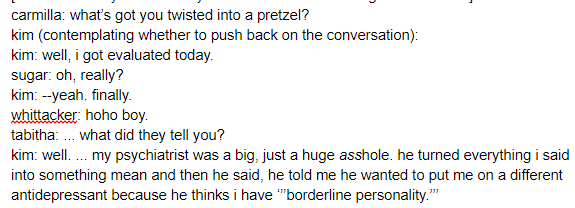
... which caused kind of a cascade effect with the pacing of this page. there were several beats that needed to happen in succession, and on top of that, i realized something else while drawing it out -- that carmilla was supposed to be shocked in a later scene about how young kim is, but she would already know, as sugar needed to say it here. i drew a thing about how doctoring the script at the point it was felt:


now the only issue left in the final product is that carmilla seems a little unnaturally silent before responding to the age that sugar said. ...as a side note, carmilla has a very good sense of hearing, so she was definitely saying SIX instead of sixteen intentionally.
on the topic of carmilla, she has a personality SIMILAR to whittacker's that was noticeable to me in this scene -- mostly because whittacker has been mostly quiet, and many of her responses are clipped and responded to by carmilla.
i even cut out some hostile banter from her, like when the characters decided what to do about the chair scarcity, whittacker could have said something indicating she wanted carmilla to not sit with them anyway, and banter with whittacker threatening carmilla after the "watch it" on this page by calling her a twig or something similar.
they both seem very geared towards pushing other people's buttons... i think the difference is that carmilla's motivation is fed directly by the response or interaction at all, whereas whittacker wants specific responses to feel in control of an interaction.
carmilla's not unwilling to make herself look like a fool to weird other people out, whereas whittacker has a desire to retain some sense of dignity or superiority. whittacker instead protects her ego by resorting to physical threats and intimidation when she feels threatened.
i think because they're both able to recognize each other as competition, there's probably also a sort of implicit obligation to tolerate each other -- if you get YOUR buttons pushed, you lose.
their interaction with each other at the end of this page catches whittacker off-guard, because it seems suddenly genuine -- carmilla's not wrong, existential questions about the borderline diagnosis's very name are common in communities -- but what she said still doesn't make any sense conversationally.
whether carmilla was lapsing into awkward Symptoms there or just succeeded at continuing to control the dynamic between the two is a mystery up for interpretation, i guess.
carmilla has definitely dominated the conversation for this scene, but she's mostly done. sugar's going to lead out this scene with kim.
the other thing i wanted to mention about her is her reaction to kim's age, which was odd, almost like she felt the loss of some "special" factor. i think she's probably had symptoms that have spiraled into her own personal mythos for her after a long time of pathologizing and structured therapeutic gaslighting. she acts intentionally weird to justify why she's treated like she is internally, but she can't project that justification onto kim. it's uncomfortable for carmilla in two ways: it threatens the sense of justification she has about institutional abuse she's endured for an intolerably long time, while also implying she may not be so abnormal or uniquely victimized herself, because kim doesn't necessarily display symptoms carmilla may identify as particularly persecuted. (and she has to act differently around a kid, obviously)
carmilla is a voluntary intake patient and a thing or two that she says about why she's there for homicidal thoughts later on might also make more sense with why she would be upset that they'll "let anybody in."
in the panel where sugar says that things she says often come out worse than she intended, the dialogue wasn't originally meant to be written there, but i decided to add it while working on the page. she was supposed to say SOMETHING, but i thought i didn't have enough room. then i felt like kim's beat felt too similar to too many moments before -- she pauses a lot in surprise or self-judgment.
it was still important to have the pause for pacing, obviously, but also because kim is confused about her reaction to sugar's sentence, and might start internalizing the specific ways the environment is affecting her thought processes.
i still thought the dialogue sugar had here could help build on the character that sugar is in drop-out... she acts differently in this comic compared to drop-out, but small off sentences where she states negative aspects of herself that she had, by the start of drop-out, clearly internalized so deeply as truth that even thinking about them briefly felt agonizing, helps her feel like the same character.
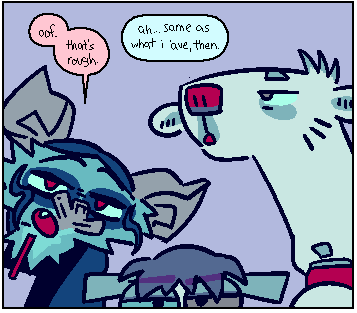
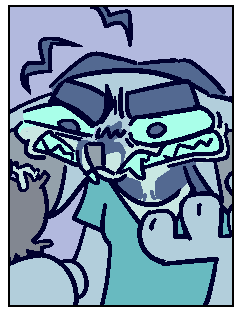
i think that's all i have to say. it feels good to finally be at a place in the story where depth has developed enough that i can start talking about character motivations and such. one last thing: i have to color these pages with the light colors first to get the shading right, even though i designed the palette around the shadow colors. it looks so fucking weird to color in during the base coloring stage:
Charlie Mead
2019-09-23 18:33:48 +0000 UTCAvi Emery
2019-09-20 17:20:51 +0000 UTC