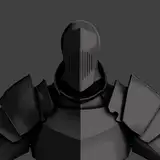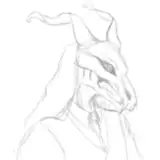
The Marquis will likely never be finished. After over a decade it remains incomplete, two volumes out of a planned five, the remainder of the work a casualty of Davis’s (justified) clashes with Dark Horse and his subsequent career in creature design for Guillermo del Toro, which one imagines pays a hell of a lot better than comics. Still, it remains an extraordinary landmark in the medium, bursting with bizarre, disturbing denizens of Hell and helmed by the titular Marquis himself, Vol de Galle, an aging former inquisitor who’s something of a cross between The Hunchback of Notre Dame’s Claude Frollo and Batman, an instantly iconic figure in his dour mask and stygian cloak. Davis’s lines are scratchy and fraying, his shadows cross-hatched into seething blackness, his cityscapes so fanatically detailed that one can pause for minutes on end just to soak in the little cornices and gargoyles and friezes, a whole city built out organically with hardly a jot of expository backstory after the opening sequence. His demons range from the grotesquely pitiable to the profane and genuinely terrifying. Especially memorable is his depiction of the Devil, titled here Lord des Diables, as a sort of doppelganger of de Galle emerging backwards from a demonic horse’s ass, a cutting little visual joke that the ex-inquisitor’s holy crusade is just that — horseshit.
The theological stuff, and there is a lot of it, isn’t exactly breaking new ground, but in its circuitous simplicity it becomes an ideal tool for character development. We see devils longing fo absolution, old soldiers bucking against the hysterical monomania of religious rule, inquisitors rendered ideologically and personally incoherent by imbibing endlessly of tortured confessions. Even the most shopworn archetype is given room to breathe and change, and as the comic progresses it deepens both in terms of Davis’s craft and its thematic concerns. The rather pat question of de Galle’s sanity gives way to the much more troubling one of how to live while doing (he hopes) the right thing in service (he discovers) to the Devil himself. The world prays, but only Hell is listening, and you’ve got to work with what’s at hand. de Galle’s voyage to Hell is the unfinished epic’s master stroke, a demented carnival of seething reds and yellows in the midst of unrelenting black and white — a glimpse of something more real, more vital than flesh or bone or steel.
The city of Venisaille overflows with corruption and licentiousness, but Davis’s work avoids the fascist pitfalls of prurient redemptive violence. What de Galle does, the purpose it serves, is murky at best, and in conflicted figures like le Courtesan we see sexuality not just as monstrous but as transcendent and transgressive. Davis’s most stunning piece of character design, her revealed form evokes transsexuality, Lovecraftian horror, and classic Gothic notions of the maiden beset by spiritual suffering. Her face, tranquilly beautiful, is a mask of the same function as de Galle’s, to conceal her true face as she pursues her mission of meting out “release” to her fellow demons, who more than damnation fear the nonbeing to which only she and the Marquis can consign them. de Gall may kill her mortal form, but there is no battle, no epic struggle or attempt at infernal seduction. She submits because like de Galle she is of both worlds, Hell and the mortal plane, but unlike the one-time inquisitor she accepts her dual role with equanimity. Killing devils in one place is as good as killing them in any other.
The anxieties Davis explores through creature design range from the sexual — many of his devils display bare genitals or position themselves in place of the genitals of the possessed — to the surgical, with exposed organs and bones a major theme. Also prevalent are invocations of Capgras syndrome and its attendant delusions as embodied by devils with missing faces or partial faces, and by devils who arrange their matter to resemble a profaned copy of a living person. In concert with de Galle’s advanced age and apparent frailty it constitutes a moving visual analysis of the abject, the human mind and body on the brink of dissolution mirroring society’s precarious and brittle state. It’s Gothic in the truest sense of the word, wretched and degraded, its players cognizant not of any goodness in the world but only of lesser evils. When de Galle finally happens upon a woman of real principle and willpower it is in the last moments of her life and as her executioner, consigned to destroy the very thing he tells himself he fights to protect. The Marquis is a true classic, an old story reimagined and told with such conviction that it feels new again.
terieu
2023-05-15 14:51:01 +0000 UTC