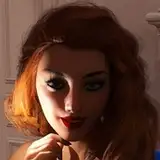
Here are women arrayed in ranks, kneeling behind glass. Each holds a number, and it is given to disgraced composer and conductor Lydia Tár (Cate Blanchett) to pick one for a massage heavily implied to lead to sex. A madame waits expectantly for her answer. This is the position Lydia has cherished and clung to for at least a significant portion of her adult life, using her position as conductor of the Berlin Philharmonic Orchestra and her status as a grant appointment judge to groom young female students and musicians as lovers in exchange for career advancement. Now, confronted with a starkly revealing mirror image of the orchestra that has been her hunting ground throughout her years in power, she flees the parlor to vomit in the street. Tár dwells at length on such questions of influence and insecurity, on how we desire to be seen and how we see ourselves, on history’s short, selective, and often cruel memory.
Blanchett is incendiary as the terse, vindictive Tár — her best and most dynamic role in years — and director Todd Fielding leans heavily into her leonine appearance, lighting her from above and in front to emphasize her broad, flat features and the swept-back mane of her tawny hair. At the conductor’s podium she’s a half-step from interpretative dance, arms flying with martial savagery, and in private she pads barefoot and in silence from room to empty room, eyes forward. Hunting. The world at her back is equal parts mystery and nightmare. Her assistant and lover Francesca (Noémie Merlant) dogs her every step, resentful and yearning, wishing for a closeness she knows she can’t recapture and is perhaps beginning to realize existed only in her mind. Her wife Sharon (Nina Hoss) watches her with weary detachment, conscious of her nature but unwilling to drag that consciousness into their marriage.
Behind them all twists the ghost of Krista Taylor (Sylvia Flote), Tár’s one-time protege and lover, battered first by Tár’s grooming and then by her rejection and blackballing from the music world into committing suicide. We see Krista only in fleeting dreams, her outline uncertain, her face obscured. She’s the past Tár refuses to see, the mortality the self-proclaimed “master of time” spends her waking hours pretending doesn’t dominate her thoughts. When the elderly woman across the hall from her atelier dies and the woman’s family put her apartment up for sale, Tár responds to their request that she keep from practicing her music when buyers are inspecting the premises by launching a campaign of vindictive improvised accordion music, self-accompanied at the top of her lungs. She is not, you see, just a thing taking up space in an apartment that will be swept out and sold the moment she stops breathing. She is not a metronome, marking time without volition. So she runs, and chases skirt, and picks fights she knows she can win, until she ensures her own irrelevance beyond a shadow of a doubt.
Jerna Van Vooren
2023-01-24 23:13:09 +0000 UTCBill Rooney
2022-12-16 19:18:16 +0000 UTC