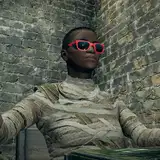
My defining flaw in all my relationships has always been my propensity for disappearing into my work. Finding a little success as a writer has only made it worse. I suppose I feel I have a better excuse now, that by burying my head in reviews and novels and comic scripts I’m providing for my loved ones against an increasingly uncertain future. In practice, it means that when I’m stressed or depressed or upset, I neglect those same people and turn away from the comfort and support they can and wish to offer me. Watching Robert Morgan’s Stopmotion felt, at times, uncomfortably close to looking into a mirror. The film’s recreation of this particular species of avoidant obsession is as meticulous as its depictions of aging and infirm but still fanatically dedicated stop-motion animator Suzanne Blake’s (Stella Gonet) micromanagement of her daughter, Ella (Aisling Franciosi).
The elder Blake, robbed of her ability to work by advanced arthritis, now realizes her creative impulses entirely through her daughter, their working relationship characterized by a sort of anti-bonding in which intimacy between two people produces profound alienation and dehumanization. Each resents the other for the parts of their personhood she inhibits, Suzanne embittered by her physical decline, Ella disaffected by her mother’s unwillingness to allow her to collaborate on her stop-motion film. They are less than the sum of their parts, but those parts are inert when separated. Suzanne’s stroke leaves Ella rudderless and disoriented, her dreams of realizing her own film sublimated into a hallucinatory girl (Caoilinn Springall) embodying her own dashed childhood ambitions. Ella has been so thoroughly unpersoned that she cannot imagine herself as the source of new art; she must displace these acts and emotions into her own imagined childhood self.
Even the film’s exquisitely produced segments of stop motion animation contain the seed of this idea, with Ella’s dolls composed of dead meat hidden beneath mortician’s wax. The veneer of creativity conceals something curdled and inert, something kept too long in the dark to function outside it. The repeated Lynchian visual motif of the ruched gold interior of the steamer trunk provides a thematic backdrop to the character of Ella’s suffering, an invocation of her deep desire to return to a state of passivity, to become not a subject but an object. Even in relation to her own creations she can only conceive of herself as something to be acted upon, tormented by stop-motion maquettes, haunted by the unfolding revelation of the story her younger self unveils to her but unable to change it. Art here is not the process of communication between artist and audience but the destruction of human connection, the undoing of the ways in which we make sense of ourselves and each other. It’s the death of being.
Maybe that's what I'm doing when I retreat into my work to avoid dealing with my own emotions. The appeal of control is there, of course. My work is definitionally what I want it to be, but if I soothe my discontent with a retreat into absolute authority every time it rears its head, am I keeping myself locked into a childish emotional dynamic that absolves me of ever having to reconcile with my own failures as a human being? Am I transferring things I need to work out with my loved ones and within myself into a safe little box where nothing can hurt me or go wrong? Stopmotion made me think about it in a way nothing else had, and even if it weren't a beautiful and insightful work of art on its own terms, that would have been enough to put me on my ass.