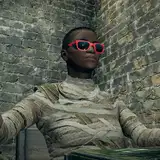
“The future is over,” says Federicci (Agustín Recondo), pronouncing each syllable like he’s tonguing the empty socket of a pulled tooth. He can’t remember where he heard the phrase, or what it means, or how it might pertain to the black magic-inflected mystery at the heart of this disturbing and ambitious film, but the dread remains. The future is over, pulled apart by a feckless, mysterious cabal of politicians and businessmen who also happen to be practitioners of brujeria, which we would call sorcery or witchcraft. There’s a satirical edge to this conceit, of course, a wry reckoning with the simultaneous existential monstrosity and dry banality not just of Argentina’s tumultuous political past and the graft and brutality it fostered but with our present global moment, characterized as it is by a vast and ever-growing uncertainty, an ignorance tended like a bonsai plant by those for whom power is its own end. The early sequence in which a frightened security guard stumbles across a murderer (Raúl Omar García) crouched over a nameless victim provides us with our first glimpse into the mechanics of the occult regime, the reified illogic and mutilated causality they employ to reshape the world.
Writer and director Cristian Ponce cleverly situates us in the harried middle of a TV newsroom operating in exile during their show’s final desperate broadcast, equal parts a scramble for the truth and a desperate bargain with soft-spoken brujo Adrián Marcato (Germán Baudino), who has agreed to confirm the conspiracy’s existence in exchange for a mysterious address for which the team hunts by means mundane and otherworldly. The script is liberally spiced with references to Rosemary’s Baby, another work in which a coven of witches foreclose on a woman’s future through her child. Here the means of control is more obscure, hidden even from its victims and their loved ones, but it too begins with children. The scenes in which the news team struggle to determine how many children the various subjects of their story have and can’t make their memories match their records are some of the most haunting depictions of black magic I’ve seen filmed, the mechanics of knowledge itself crumbling before our eyes.
Ponce’s camerawork is heavily influenced by the film noir of the 1940s and 50s, steeped in shadow and alive with paranoia. His long, slow shots build a tension that never quite resolves, a sense of stress that mounts with every answer the desperate team uncovers. They have the pieces to the puzzle, but the images are gone, blanked out. They can’t remember their own colleagues. They’re hunting for a house they don’t know in a neighborhood they’ve never been to. Are they fighting against the end of the world as orchestrated by a faceless evil, or unknowingly enabling it in service to Marcato? As each veil comes crashing down, revealing absent memories and forgotten modern technology, is the world coming apart or somehow returning to its unspoiled form? History of the Occult doesn’t answer these questions. Instead it leaves us, like its characters, fighting to make sense of a gutted chronology, to understand the whole of a world so extensively redacted and effaced that perhaps it can never be known again. Not truly.