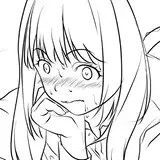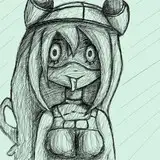
1. In Manga Studio, I start with a very rough sketch with big fat pencils. The fat pencils force me to keep the sketch loose without getting too caught up in the details This sketch was suggested by LeilaStoat.
2. Better sketch. I played a little more with the details during the sketch stream.
3. Final sketch. Now I go back and do a more detailed sketch, working out the the body, clothing, and hair. I used a perspective ruler to line up the floor and walls.
4. Inking. I use a variable-width inking brush for the characters and a constant-width brush for hard things (the buckles) on vector layers. I use lots of different layers for different parts, which makes it easier to overdraw and erase as needed. I also went ahead of inked the shape for the eyelashes because the brush stablization in Manga Studio makes it a lot easier than doing it in Photoshop later. I exported the inks in multiple layers for the dolls, the background, and the window.
5. Color blocking. In Photoshop, I convert the imported lines to a folder with a mask and put a solid black layer in the folder. (CTRL-click RGB in the Channels tab, invert the selection, create a mask from the selection.) This will come in handy later when I color the linework. Then I create another folder and start creating the basic color blocking.
6. Cast shadows. I make a new dark brown layer set to multiply and start painting in the cast shadows with soft brush, using a smaller brush in places where the object casting the shadow is closer to the thing the shadow is on.
7. Form shading. I create a dark brown solid color layer (linear burn) and start painting in the basic form shading with a soft airbrush. Except for the hair, which gets its own dark brown layer but with linear burn blending for more richness. I also use a smudge tool on the hair and various creases in clothing and skin to create detail.
8. Backlight. The backlight here is cast by the green and red lights on each side of the window display. I created a folder with a mask and put in a pale red solid color layer set to screen. All of the backlight was painted on folder mask. When I combined it with the form shading, backlighting really makes the characters pop. Since the light is coming from small lights on each sides, I painted the backlight strongly on just one side of things close to the side and thinner on things closer to the middle. I used both a soft brush (for the shiniest parts like the buckle and lips) and a soft airbrush (for everything else). I don't use any backlight on non-reflective objects. When it's done right, it should look like real lighting from a different angle. And again, smudge the edge of creases and hairs. Inside the folder, I added a pale green layer with a mask then filled the mask with random, scattered soft spots so that the backlight looks like it is picking up more green or red at different places.
9. Shiny. I used a solid white layer at for basic shine on lips, nails, and shoes, and solid white set to overlay (which makes a richer shine) for the hair shine. Painting the hairshine, I use a variable width sharp brush, then go over it with an airbrush to give it a little glow. On the satin, I used a very soft airbrush for the shine. After painting all the shine, I use the cast shadow layer to make a selection and delete the shine from anywhere covered by shadow.
10. Skin effects. For the blush, I add in a light red layer, airbrushing just on the same area as the skin for the joints and face. I use the same technique for the eyeshadow.
11. Glow. I added a soft glow on top of the lights by adding red and green layers above the inks (but below the window layers) and stamping big soft circles around each light.
12. Colored linework. Going back to the linework folder, I started adding new solid color layers, using the mask to paint the color of the linework. Since the new layers are inside a folder with a mask defining the linework, I don't have to be very precise when coloring the lines. I always add new color layers below the ones I already did so that I can be sloppy in the areas that are already covered by colored linework. Everything soft gets colored linework. Hard objects stay black.
13. Eyelashes. Eyelashes are done with a folder containing a solid grey layer and a solid black layer. Using the lashes I made earlier with a variable width brush, I add a few thin streaks on the grey layer mask to add depth to the lashes and soften the look with a few strokes of a soft airbrush. For the tears, I used a white layer with the fill turned down just a little and add a layer effect with white inner glow set to 100%. After, I add a new white layer to paint in the shiny highlights.
14. Wall texture. I added a simple wallpaper pattern and a grungy texture to the back walls, making sure to use distortion to match the perspective of the walls on each side.
15. Glass. For the glass, I added a solid layer of white, turned down to 10% opacity, behind the window layers but in front of the dolls. Then I added a few shiny streaks to each surface.
16. Frost. I created a new frost brush by tracing from a photograph of frost on a window, creating a simple triangular pattern of frost spikes. Then I gave the brush lots of scatter, angle, and a little bit of size randomization. I used the brush to paint on a white layer, set to medium opacity, around the edges of each window. On the sides, I painted in a rectangular pattern and then used distortion to match the perspective of the window.
17. Snow. I used a variable-width solid brush to paint the shape of the snow in an off-white layer. Then I added grey form shading and a layer of grey noise, set to overlay, on top.
18. For the signs, I made a few simple vector shapes then added layer effects for wood texture, bevel, drop shadow, and an outer stroke. Then I added the text and I was done.