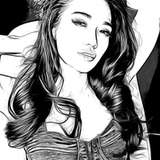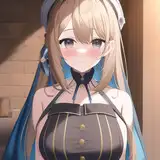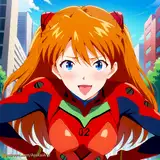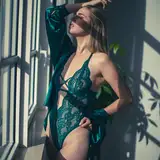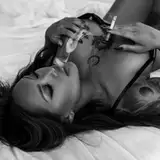
1. In Manga Studio, I start with a very rough thumbnail sketch with big fat pencils. The fat pencils force me to keep the sketch loose without getting too caught up in the details. I went a little more detailed than usual with the faces because I wanted to make sure I was matching the way I drew them last year so I pasted in the faces from last year and traced the proportions for consistency.
2. Final sketch. Now I go back and do a more detailed sketch, working out the the body, clothing, and props. This is the longest step in the process because it is when I research the outfits, try out different hairstyles and expressions, and fine tune every lock of hair. This is also when I fix the proportions, make sure the legs are the same length, and so on.
3. Inking. I use a variable-width inking brush for the characters and a constant-width brush for hard things on vector layers. I use lots of different layers for different parts, which makes it easier to overdraw and erase as needed. To save time and ensure consistency, I re-used the ink for the angel's legs and both of their wings from the previous pictures. I also went ahead of inked the shape for the eyelashes because the brush stablization in Manga Studio makes it a lot easier than doing it in Photoshop later.
4. In Photoshop, I convert the imported lines to a folder with a mask and put a solid black layer in the folder. (CTRL-click RGB in the Channels tab, invert the selection, create a mask from the selection.) This will come in handy later when I color the linework. Then I create another folder and start creating the basic color blocking. I like to do all my color blocking by making a folder and then filling it with different solid color layers for each section of color, whch makes it easy to change a color later. This is a very fussy way to do it and it's probably much simpler to just fill a single raster layer with flat colors.
5. Form shading. I create a brown solid color layer (linear burn) and start painting in the basic form shading with a soft airbrush. Except for the hair, which gets its own brown layer but with linear burn blending for more richness.
6. Cast shadows. I make a new dark brown layer set to multiply and start painting in the cast shadows with soft brush, using a smaller brush in places where the object casting the shadow is closer to the thing the shadow is on.
7. Backlight. I used a pale blue layer for backlight, set to screen. When I combine it with the form shading, backlighting really makes the characters pop. I used both a soft brush (for the shiniest parts like the lips) and a soft airbrush (for everything else). I don't use any backlight on non-reflective objects. On the hair, I use a smudge tool to streak the backlight so that it suggests strands of hair. When it's done right, it should look like real lighting from a different angle.
8. Shiny. I used a solid white layer at for basic shine on lips, eyes, and other basic shiny things and solid white set to overlay (which makes a richer shine) for the hair shine. Painting the hairshine, I use a variable width sharp brush, then go over it with an airbrush to give it a little glow. After painting all the shine, I use the cast shadow layer to make a selection and delete the shine from anywhere covered by shadow.
9. Bed sheets. I used another brown layer (linear burn) for the wrinkles in the bed sheets. I used a soft airbrush to paint large dark sweeps away the characters, then invert the brush and paint thinner, strokes away from the characters. I added a darker impression where the characters touch the sheets directly, then added a few small light spots right at the edge of the creases, a shart distance from the characters.
10. Sparkles. I added a greyscale sequined texture on top of the halo and set it to vivid light.
11. Colored linework. Going back to the linework folder, I started adding new solid color layers, using the mask to paint the color of the linework. Since the new layers are inside a folder with a mask defining the linework, I don't have to be very precise when coloring the lines. I always add new color layers below the ones I already did so that I can be sloppy in the areas that are already covered by colored linework.
12. For the blush, I add in a light red layer, airbrushing just on the same area as the skin for the cheeks and other cheeks. I used the same method to add the pink eye shadow.
13. Eyelashes are done with a folder containing a solid grey layer and a solid black layer. Using the lashes I made earlier with a variable width brush, I add a few thin streaks on the grey layer mask to add depth to the lashes and soften the look with a few strokes of a soft airbrush.
14. For the drool, I used a white layer with the fill turned down just a little and add a layer effect with white inner glow set to 100%. Then I use the mask to soften where is touches the skin (or, in this case, where the invisible skin would be if you could see it). After, I add a new white layer to paint in the shiny highlights.
15. Wobble. I made four copes of the halo and distorted them so that they looked like they were moving more toward the front than the back. Then I added a soft mask so that they faded out closer to the back.