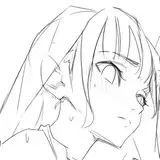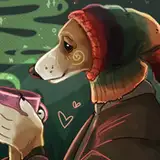
1. In Manga Studio, I start with a very rough thumbnail sketch with big fat pencils. The fat pencils force me to keep the sketch loose without getting too caught up in the details.
2. Final sketch. Now I go back and do a more detailed sketch, working out the the body, clothing, and props.
3. Inking. I use a variable-width inking brush for the characters and a constant-width brush for hard things on vector layers. I use lots of different layers for different parts, which makes it easier to overdraw and erase as needed. For the fur and chains, I used special brushes I made earlier, based on my own drawings. I also went ahead of inked the shape for the eyelashes because the brush stablization in Manga Studio makes it a lot easier than doing it in Photoshop later.
4. In Photoshop, I convert the imported lines to a folder with a mask and put a solid black layer in the folder. (CTRL-click RGB in the Channels tab, invert the selection, create a mask from the selection.) This will come in handy later when I color the linework. Then I create another folder and start creating the basic color blocking. I like to do all my color blocking by making a folder and then filling it with different solid color layers for each section of color, which makes it easy to change a color later. This is a very fussy way to do it and it's probably much simpler to just fill a single raser layer with flat colors.
5. Form shading. I create a dark brown solid color layer (linear burn) and start painting in the basic form shading with a soft airbrush. For the hair, I used color burn for richer shading and I used a variable-width soft airbrush to smudge detail into the shadows, picking up the shape of the hairs.
6. Backlight. A very desaturate orange for the sun and pink for the neon (screen) painted with a soft airbrush. When I combine it with the form shading, backlighting really makes the characters pop. Because both of the secondary lights are very strong, I give almost everything a backlight instead of just the shiny parts.
7. Cast shadows. I make a new dark brown layer set to multiply and start painting in the cast shadows with soft brush, using a smaller brush in places where the object casting the shadow is closer to the thing the shadow is on.
8. Shiny. I used a solid white layer for the primary shine and painted spots and streaks using a hard variable-width brush. After painting all the shine, I use the cast shadow layer to make a selection and delete the shine from anywhere covered by shadow. I also added some soft white glow to the eye shine.
9. For the blush, I add in a light red layer, airbrushing just on the same area as the skin for the cheeks and other cheeks. I use the same method to add color for the eyeshadow.
10. Colored linework. Going back to the linework folder, I started adding new solid color layers, using the mask to paint the color of the linework. Since the new layers are inside a folder with a mask defining the linework, I don't have to be very precise when coloring the lines. I always add new color layers below the ones I already did so that I can be sloppy in the areas that are already covered by colored linework. By coloring with lines similar in color to the objects, I give those objects a softer, more organic feel, which contrasts strongly with the few hard objects that I keep in black linework.
11. Eyelashes are done with a folder containing a solid grey layer and a solid black layer. Using the lashes I made earlier with a variable width brush, I add a few thin streaks on the grey layer mask to add depth to the lashes and soften the look with a few strokes of a soft airbrush.
12. For the sweat, I used a white layer with the fill turned down just a little and add a layer effect with white inner glow set to 100%. Then I use the mask to soften the edge where it touches the skin. After, I add a new white layer to paint in the shiny highlights. Fun fact: I think these the first tears of *joy* I have ever drawn for my patrons.
13. Texture. To give the wool a little texture, I added a layer of noise (made from solid gray with heavy Gaussian noise applied, then scaled up by about 3 times the size). I set it to overlay and lowered the opacity. I place it above the shading layers so that it picks up the richness of the shading. I also added a faint grungy texture to the wall. Giving walls a little texture always makes them seem a little more real.
14. I added a few pink hearts to a new layer then added some bevel and a strong outer glow to make them look like neon.
15. Window. I sketched in some vague shapes for the outside and applied a heavy Gaussian blur. Then I added a few white glass streaks.