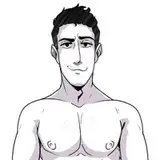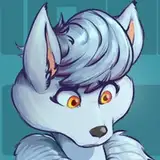
1. I start with a basic sketch to work out the layout, pose, and proportions.
2. Final sketch. I sketch the characters in full detail.
3. Inking. I use a variable-width inking brush for the character and a constant-width brush for hard things on vector layers. I use lots of different layers for different parts, which makes it easier to overdraw and erase as needed. I also went ahead and inked the shape for the eyelashes because the brush stablization in Manga Studio makes it a lot easier than doing it in Photoshop later.
4. In Photoshop, I convert the imported lines to a folder with a mask and put a solid black layer in the folder. (CTRL-click RGB in the Channels tab, invert the selection, create a mask from the selection.) This will come in handy later when I color the linework. Then I create another folder and start creating the basic color blocking. I like to do all my color blocking by making a folder and then filling it with different solid color layers for each section of color, whch makes it easy to change a color later. This is a very fussy way to do it and it's probably much simpler to just fill a single raster layer with flat colors.
5. For the backdrop, I blocked in the surfaces in basic flat colors.
6. Then I added texture to the floor and walls, using greyscale textures set to overlay, then using distortion to match them to the perspective of each surface.
7. I filled in the silhouettes for the partygoers, using shades based on the wall color but slightly darker, so they would feel distant.
8. I added gradient shadows to the surfaces, to make the scene darker closer to the viewer.
9. I collapsed a copy of the backdrop and adde some blur, then added a mask and used a radial gradient so that the hall becomes blurrier with distance.
10. Form shading. Next, I created a dark purple solid color layer (linear burn) and start painting in the basic form shading with a soft airbrush. I always start with shading at full and then use the airbush to paint away the shading, painting with light. For the hair, I used color burn for richer shading and start with a general, soft airbrush for the overall shape, then used a variable-width soft airbrush to smudge detail into the shadows, picking up the shape of the hairs.
11. Cast shadows. I make a new purple layer set to multiply and start painting in the cast shadows with soft brush, using a smaller brush in places where the object casting the shadow is closer to the thing the shadow is on.
12. Backlight. I used a desaturate solid color layers (screen blend mode) painted with a soft airbrush. When I combine it with the form shading, backlighting really makes the characters pop. I don't use any backlight on non-reflective objects.
13. Shiny. I used a solid white layer for the primary shine and painted spots and streaks using a hard variable-width brush. After painting all the shine, I use the cast shadow layer to make a selection and delete the shine from anywhere covered by shadow. For the shine on the hair, I started with thin strokes with a variable-width brush, then use a smude tool to add detail and softness to the tips, then use an airbrush to add a soft glow to groups of streaks, then use an airbrush to fade the tops and bottoms of streak groups, and finally use a soft round brush to erase a few streaks in the middle of each group.
14. To make the characters feel more in shadow, I added a hue/saturation adjustment layer above the form and cast shadows, below the secondary light and shine, making the scene fully colorized the same hue of purple as the shading, with a medium-low saturation and only lowing the brightness a small amount. The idea is to mostly show shadow by making everything more monotone purple in a day-for-night effect. Then I used an airbrush on the mask to limit the adjustment to the parts I wanted to seem more in shadow.
15. Using my linework for the costume bones as a guide, I added an off-white layer above the colors. I didn't keep the linework, just used it to guide the fill.
16. For the blush, I add in a light red layer, airbrushing just on the same area as the skin for the cheeks and places where bone is near the surface of the skin.
17. I use the same approach for the make-up and blush zag.
18. Colored linework. Going back to the linework folder, I started adding new solid color layers, using the mask to paint the color of the linework. Since the new layers are inside a folder with a mask defining the linework, I don't have to be very precise when coloring the lines. I always add new color layers below the ones I already did so that I can be sloppy in the areas that are already covered by colored linework. I like to keep using black lines on the hardest objects to give it a contrast with softer objects.
19. Eyelashes are done with a folder containing a solid grey layer and a solid black layer. Using the lashes I made earlier with a variable width brush, I add a few thin streaks on the grey layer mask to add depth to the lashes and soften the look with a few strokes of a soft airbrush. I also charged the color of the lashes to match the hair linework where the eye is obscured by the hair.
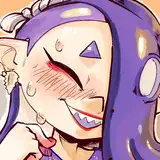
20. For the sweat, I used a white layer with the fill turned down just a little and add a layer effect with white inner glow set to 100%, a bevel effect set so that the highlight as on the bottom, and a subtle drop shadow. Then I use the mask to soften the edge where it touches the skin. After, I add a new white layer to paint in the shiny highlights. For any sweat passing through the heavy skull make-up, I went back and used an airbrush to softly erase a streak from the running sweat.