SamSuka
Primitive Technology

patreon


Tilled Capped Mud Walls

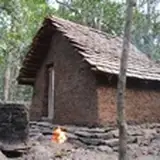
I built mud walls that I capped with roof tiles so they don't dissolve in the rain. This method is good for building in wet weather, where the tiles can be taken off to add more layers. I intend to build a roof on the walls when it's tall enough. Much appreciated.

Tilled Capped Mud Walls

Comments

It doesn't matter for a single row as seen in this video, but will be important for a larger roof later with multiple rows (coming up in next video). The first layer of a row is made of tiles with curved side facing up. The wide end of the tile in the lower row has the narrow end of the tile in the upper row sitting on top of it. This is so that the water is always flowing from one narrow end into a wide end preventing leaks. The tiles that go over the gaps between the columns of tiles are turned curved side down and narrow end pointing up. This is because the gaps formed are the opposite of the under tiles laid bellow. Thanks.

Primitive Technology

Maybe this should be obvious, but how come the roof tiles are tapered?

Mitch Berkson

Thanks James, all good ideas to consider.

Primitive Technology

ah sorry, I didn't mean these current walls should be the storage area, I meant you could easily use all the materials you have to add a storage extension to the current brick/tiled hut you currently have, I get that that the new walls are an entirely separate space. Well.. Even there it might be nice to have an external awning for supplies etc.

James Tyrrell

The structure I'm building with these mud walls should make a good storage area indeed. My plan with these mud walls is to extend them upwards and give them a gable profile top. That is to say, the top of the walls will be a triangle. Then I'll put poles resting on top of and between the 2 walls to form a roof. Then the roof will be covered in tiles. When finished, the structure will look like the brick hut but with only 2 walls, the lower sides will be completely open. I'm just finishing the walls today and will start cutting the timber tomorrow. Thanks.

Primitive Technology

I guessed you had thought of it but it was when I saw you construct the tile capped mud walls I realized you could (with all the existing bricks and tiles) create a storage area pretty quickly

James Tyrrell

Yes, I've thought of having the roof extend over the end of the gables for an out doors space. This could be done by having the purlins longer than they currently are. Thanks James.

Primitive Technology

I suddenly had a thought, you'd save a lot of space you use for charcoal / ash bricks / caline pellets which you stock up inside your brick shelter if you created a tile topped awning on the side of your brick house, mudbrick walls and sand covered floor as a dry storage extension to give you more room in the main area.

James Tyrrell

I use them for scooping iron bacteria into pots from the creek. I leave them in the creek bed and then there will be a flash flood and it washes them away. I've lost 2 good ones so I made another one this firing. Thanks.

Primitive Technology

Why do you keep losing your bowls?

Julian Gonggrijp

Thanks Lyda, I made one here: https://youtu.be/Gqhxe_pL6Ws . But I could probably re-visit it in future. Thanks.

Primitive Technology

i love seeing you do lots of clay work in the last few videos! have you considered building a primitive potrery wheel?

Lyda

Thanks Steve.

Primitive Technology

Makes sense thanks John.

Steve Maynard

Yes, I'll build them into gable end walls (tops of the walls will be triangular) and then span the 2 walls with wooden poles. Then I'll cover the poles with roof tiles to form the roof. Th e roof will extend out from the ends of the walls by about 25 cm to keep them dry. Thanks.

Primitive Technology

Yes but by the time they get that high I'll have built a roof on top of them and the eaves will extend well over the wall ends. I intend to build the walls up to 1.25 m tall before tapering them in to form gables, the rest of the 2 m will be triangular. Then a roof will be made of horizontal wooden poles that span the 2 walls with the ends of the poles extending out about 25 cm over the mud walls. Then the tiles are laid on the poles to finish the roof. This should keep the walls dry in the rain. Thanks.

Primitive Technology

It's to check that they've been fired properly and won't dissolve in water. The reasoning being that it's better for them to dissolve in a test than in the finished roof when it rains. The same goes for bricks too. Thanks.

Primitive Technology

You likely explained it in a previous video but why do you soak the tiles and bricks after firing them?

Steve Maynard

I am struggling to see the idea behind the mud walls. Once they get tall, rain WILL fall on them from the sides even if you have tiles on top. Wouldn't that make them (dangerously) unreliable?

Mario Stoilov

Thanks for the video, very interesting project. Do you have something planned for those mud walls or it was a concept project?

Faralis


More Creators