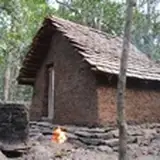
Water powered forge blower
Added 2025-03-06 21:32:15 +0000 UTC
I made a water powered forge blower. I tried 2 designs, the first being a large diameter, under shot water wheel with a belt drive going to the fan, and the second being a smaller diameter water wheel powered by a falling stream of water directly driving the fan attached to the same shaft. The second method was the only one that worked reliably although I may attempt the first method later. The method that worked was simple and effective although it gave less airflow than a hand powered blower. This may be improved by increasing the height of the water fall as water falling accelerates the longer it drops. Much appreciated.
It is yes. The water spout would need to extend over the bank of the creek. Thanks.
Primitive Technology
2025-04-02 20:17:47 +0000 UTC
Very cool. Though it's now quite vulnerable to water height / flood.
Hizuna
2025-04-02 15:12:33 +0000 UTC
I'll give you a project to start with that is not so primitive but will give a starting point for smelting. Get bricks to build the furnace and build the furnace as I do in my videos (4 bricks to a layer on their sides, 3 layers high). Other wise build the furnace from mud and make it about 12.5 cm diameter at the base and 50 cm tall, with a pit 12.5 cm deep. Buy charcoal and only use it, no wood for preheat as the neighbours will complain about smoke (charcoal is largely smokeless). Cut the charcoal to 2.5 cm average lump diameter. Use a hair drier and extension cord or cordless blower as air supply. If you can't find clay, make the tuyere from mud moulded around a stick, dry it and place it into the base of the furnace on a 15 degree angle downwards and penetrating 2.5 cm from the inner wall of the furnace. To do the smelt, light charcoal and get a fire in the furnace with the blower for 1 hr preheat. Then with the furnace full of charcoal add 500 g of charcoal and 200 g ore per 5-7min. Do say a minimum of 6 charges and let it burn down to tuyere level. You should get a mass of slag with cast iron droplets in it. Break up the slag when cool, the slag will crush easily while the iron won't. Use a magnet to pick them out. Slag will be weakly magnetic while the iron droplets will be as strongly attracted to it as any iron item will. Try this experiment and let me know how it goes. Thanks.
Primitive Technology
2025-03-30 00:21:06 +0000 UTC
i do wanna ask, i've found a large amount of banded iron ore and small pyrite crystals, as i'm unable to find the iron sludge you speak of, how would one properly smelt the ore, as i also cannot seem to locate any form of clay, and i am currently stuck to my backyard as i haven't found a closeby area where i can practice primitive technology, i live in st. louis, how would one get clay aside from going to a creek or lake, or buying it?
Max O'Hara
2025-03-29 23:43:05 +0000 UTC
Thanks!
Primitive Technology
2025-03-08 03:40:03 +0000 UTC
Beautiful to watch!
A Rare Bog, A Rattlin' Bog
2025-03-08 03:03:10 +0000 UTC
Yes a trompe would require a higher drop but if I find such a drop I'll give it a go. Thanks.
Primitive Technology
2025-03-07 21:51:56 +0000 UTC
The venturi effect might be used if the setup aims to suck, rather than blow, the air through the furnace. Not sure how easy that effect is to reproduce with primitive technology, though.
Julian Gonggrijp
2025-03-07 21:22:16 +0000 UTC
To echo everyone else, great job! I had thought about a trompe earlier but doubt you will have the height (or the resources to create that much pipe). An overshoot water wheel might be more efficient, especially if you can find a way to make cupped paddles.
Tim Alan
2025-03-07 21:21:50 +0000 UTC
Yes, I've pulled the spout of the blower away from the base of the tuyere so that there was an air gap and found not much of a difference. I could try again in future but so far it doesn't seem to do much. Thanks.
Primitive Technology
2025-03-07 11:14:32 +0000 UTC
It's less than the hand powered blower. The spindle was getting about 6 revolutions per second with the fan attached compared to 8 per second with the alternating direction blower (see older videos) and 16 revolutions per second with the one way spinning blower (start of video). It could probably be improved by increasing the water fall height though. I plan to move the forge to the water as that is easier. Thanks.
Primitive Technology
2025-03-07 11:12:02 +0000 UTC
In relation to the previous about Bernoulli's principle, have you done any experiments with different sized opening on the tuyere? Practical examples of Bernoulli's principle online suggest that you may be able to increase the volume into the furnace by having a greater ratio of tuyere inlet to blower outlet, and not sealing the gap. The idea being that as high pressure air exits the blower and enters the tuyere, it drags low pressure air into the tuyere with it. An example of this idea can be seen here. https://youtu.be/XP6oqIic4lo?si=LpZEKNob9_c_UfQI
JONATHAN POWELL
2025-03-07 09:58:35 +0000 UTC
I love this video! It seems to work great as a proof of concept. It was hard to gauge from the video, but was the airflow fast enough compared to hand fanning? And are you planning to move the water to your forge, or the forge to the water?
Thomas G
2025-03-07 08:44:55 +0000 UTC
There's a device called a tompe that does that with no valves or moving parts which is basically a pipe more than 3 m tall with straws in the top so as the water runs into it, it suck air bubbles in through the top. The bubbles and water then run to the bottom where there is a plenum (upturned bucket) that captures the rising bubbles while letting the falling water out. A hole in the plenum allows the air into the forge under pressure. They were used in iron smelting and forging in the past. I've considered it before although I've heard they need to be tall for sufficient air pressure to build. As you say, the air is also cold but not wet as might be expected as the water vapor condenses in the bubbles when under pressure. I may look into one and see. Thanks.
Primitive Technology
2025-03-07 05:12:50 +0000 UTC
Love the video. But it seems like there must be a more direct way to turn falling water into a jet of air (with fewer moving parts to wear down or seize). A stream of water falling past an opening should suck air in by the Bernoulli principle right? Can that somehow be turned into a blower with the right shape of clay aqueduct? What if you made a shape like a K out of tubes; would water flowing down the stem pull air in from the top right and push it out through the bottom right? ... But then again, any design that involves the air touching turbid water will probably make an output jet that is too cold/wet for a furnace? ... How about slowly filling a large clay vat with a small hole in the top for the air to escape? To make it continuous you'd need two vats and some valves....
Adam B
2025-03-07 03:47:44 +0000 UTC
It's actually drier and more still than normal, the cyclone sucked the heat and moisture away from here. Much appreciated.
Primitive Technology
2025-03-07 02:24:51 +0000 UTC
Great video, as always. I hope you aren't affected by TC Alfred, stay safe anyway during the wet season.
Kiteman24
2025-03-07 02:07:11 +0000 UTC
Thanks Amy, I always try to put in fire making in videos these days. Agreed on the furnace, I was tempted to cut the footage down but left it longer as I think people like watching more of it. Much appreciated.
Primitive Technology
2025-03-07 00:24:33 +0000 UTC
What a great angle you got on the firemaking! It was lovely to watch!
I could watch that furnace operate for an hour. It's so hypnotic!
Amy Tobol
2025-03-06 23:51:18 +0000 UTC
Thankyou
Primitive Technology
2025-03-06 23:34:08 +0000 UTC
Yes, I think it can be improved by making the water fall from a greater height. I'll revisit it in future. Thanks.
Primitive Technology
2025-03-06 23:33:48 +0000 UTC
well done
Andrew K Dickey
2025-03-06 23:31:56 +0000 UTC
The same shaft approach looks quite promising!
Julian Gonggrijp
2025-03-06 23:27:31 +0000 UTC
Captain planet for those who aren't old enough to remember. Thanks James.
Primitive Technology
2025-03-06 23:13:54 +0000 UTC
I'm sure there's a cpt planet joke there somewhere about when fire, water, earth and air combine!
James Tyrrell
2025-03-06 22:47:41 +0000 UTC