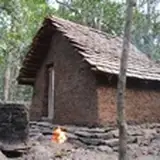
I took the iron I already smelted and re- smelted it. The iron was old and rusty from forging experiments. Iron oxidises faster when in the forge due to the hot and oxidising conditions. So I tried smelting it again to turn the rust back into iron. The first attempt involved charging the iron into a furnace in a single charge. The results were mixed, the iron was in separated pieces though the iron was softer and could be slightly cold forged. Next the iron was included in an iron smelt with fresh, roasted ore. 3 charges of ore were charged, then the scrap iron and then another 3 charges of ore. The result was cleaner but the iron was still in separate pieces. Next, an attempt was made to consolidate the iron in a forge. Bricks were taken off the furnace to reduce its height, to form a forge. The iron was charged into the forge and heated in front of the blast to consolidate it. The iron came together a bit but was still in separate bits. The iron was softer and more malleable though. Finally, the iron was put in a crucible with iron ore to decarburise it further. The iron was heated and it became absorbed into the slag. Nearly all of the iron was lost as oxide. I learnt some things from this project. One of the difficulties was not having the iron in one piece as the small pieces of iron tends to get lost in the coals. Next time, I'll likely try a crucible (without iron oxide in it) just to consolidate the freshly made cast iron prills. Once the iron is in one piece, I'll attempt to decarburise it and forge it with light hammer blows.
Much appreciated.
Primitive Technology
2025-04-04 03:47:59 +0000 UTCAmy Tobol
2025-04-04 03:42:51 +0000 UTCPrimitive Technology
2025-04-04 00:35:03 +0000 UTCSteve Maynard
2025-04-03 23:45:39 +0000 UTC