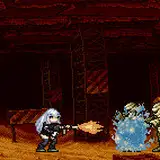
Now, Barsoom is a fantasy world so maybe realism is unwelcome, but even so I've been thinking about the habitability of Mars, the in-universe laws of nature and available technology, and whether I should change anything, and I think I might. Like mentioned earlier, Burroughs work is more or less in the public Domain (though this doesn't stop litigation), except for trademarks which can be renewed whilst in use. Conceivably Barsoom could be/get trademarked so I've considered changing the name and the properties of Mars while I'm at it, whilst keeping it intact in spirit (the notions and feel of the place).
I could change the name to Nasoom, Rezoom or such. Mars orbits at 1.52AU (Earth being 1AU), but what would happen if it was moved inwards a bit, to say 1.33AU?
This would shorten the Martian year down to 1.53 Earth years from 1.88 (calculated by Kepler's 3rd law). To keep the 668 Mars days per Mars Year, spin could be increased to some 20 Earth hours -> (1.53*365.256*24)/20.08 = 668
A faster rotation could possibly help to even out the temperatures, but a healthy atmosphere is also required for this. Barsoom has atmospheric plants which somehow replenishes the atmosphere. The ice caps are an important feature in the story, so perhaps axial tilt should be kept at a minimum.
Surface temperature is decided by several factors, such as distance to the sun, atmospheric greenhouse effect, and albedo. Dark stuff absorbs light and gets hot in the sun. A mirror finish will reflect a lot of the energy back out into space. I read that without an atmosphere, Earth temperature would be some 40 degrees cooler, which of course would freeze water, and increase it's albedo.
A molten core and gravitational distortions in moon systems can affect temperature, but not that much afaik. Most of the energy of the Earth's core doesn't make it to the surface as heat. Mars is thought to not have an active hot core like Earth does, but a core is still important for atmospheric retention (magnetic field -solar wind stuff), so I decided to give my Mars a relatively large core. This would give the planet a density similar to that of Earth. I set it to 5.6, which results in a new gravity of 0.54G, 5.29m/ss. It'll increase atmosphere retention too. I kept the radius of 3380km (about half of Earth).
Mars has two moons, Phobos and Deimos. They are relatively small, small enough to not be rounded smooth by gravity. However, they orbit much closer than our moon (which has moved away over the years) making them quite a spectacle. But a good fantasy planet needs big multiple moons in the sky for decorative purposes, and moons are also healthy for the planet. So, I might bump them up in size.
With larger moons orbiting so close to the planet, I suspect they might be tidally locked, but maybe also not stable due to gravitational interference and resonances. I could integrate this into the story... perhaps the inner moon is very reflective, not tidally locked, and unstable, offering an early hint that it was artificially introduced "recently" in geological terms.
Supposedly Mars still has significant amounts of water trapped in a frozen state. This might not be the case for my warmer Mars, so where did the water go (the story requires it to be missing). Well, it's up there in the sky! Don't know who put it there, but there it is. A high albedo.. maybe a shell might prevent it from sublimating into space when heated by the sun.
I've had this idea for a while that I've been meaning to use somewhere... what would happen if you gently, gently placed an ice asteroid on the surface of a planet (which could presumably use some water)? It would initially be very cold of course, but the tremendous stress would cause all sorts of effects, including quakes and heating. I'm thinking that my OP MC eventually acquires the power to do this as an endgame move (after all the dealings with the elder gods maybe she lost a few sanity points and decides to try it). I don't know the maths of it, but heating 1 liter of water 1 degree C is 4.2 KiloJoule, which might be the same as 1 gram of TNT.
All of Earth's water could fit in a 1380km sphere, but Mars doesn't need that much. How about a 100km sphere? This yields a volume of 523,598,775,598,299 m3. A ton (m3) is 1000 liters (larger frozen, but whatever), which all needs to be heated some +280 degrees C to reach a pleasant fluid state.
Kilojoules needed = 523598775598299 * 1000 * 280 * 4.2
Well, that's a large number. How about measuring it in nukes, e.g. MegaTons? A MegaTon appears to be 4,184,000,000,000,000 Joules, so I'll divide by that.
147,168 MegaTons to melt the water-ice. It wouldn't be a perfect conversion to heat of course. There'd be some side effects but never mind those - it's really nothing to worry about! Perhaps if MC can move/gate an entire moon, also changing momentum/differential, it might be possible to change it into heat as part of the process? Phobos for example travels at 2138m/s around Mars. What's that in kinetic energy?
(KG_mass/2) * MSec_velocity^2
((523598775598299000/2)*2138^2)/(4184000000000000) = 286,017,333 MegaTons of kinetic energy. So way more than needed? I likely made mistakes with these calculations though (._.U)
---
As for the sword, warriors don't use shields or armour on Mars and the fights are very intricate, so a rapier shape might be standard. I combined my design with a 14th century type sword as I like those. Rapiers go well with small bucklers (possibly exotic hand armour).
---
What should I do with the map? I might keep keep the city locations from Burroughs' vague map sketch. Many geographical features could remain in place too, but I'd like to expose the canals and irrigation system a bit as I find the whole canal-Mars idea interesting in a vintage way. The setting becomes a bit of a mess later on so I might sack depreciated cities. There's quite a few fan-made maps out there, each taking a different route. I used an old canal map here but it might be upside down (if drawn south of equator?) and even mirrored (maybe a telecope thing?)
---
The 8th ray is explained as being the lifting power of reflected sunlight... it- it doesn't really make sense. I might change it to being a form of solar radiation or gravitational wave which normally doesn't interact much with normal matter. On the grand scale it's responsible for the expansion of the universe (Dark Energy *cough cough*). The Martians found a way to trap it in the ship buoyancy tanks where it will exert stronger interaction (antigravity) during its lifetime. This opens up other applications of course, such as construction of near-perpetual-motion machines. Possibly the Martians are kind of degenerate savages (as implied by their insistence on naked swordery), not really understanding the technology of their ancestors. I need to finish A Canticle for Leibowitz by the way.
Well, that was a bit wordy, but maybe you're here for it.