Alchemy - 31/7/2023
Added 2023-07-31 16:47:22 +0000 UTCSOURCES
[1]: The Alchemical Choir: A History of Alchemy by P.G. Maxwell-Stuart
[2]: The Cambridge Core Alchemy Reader by Stanton J. Linden
C.T. KELLY’S SPEEDRUN GUIDE TO ALCHEMY V1.0 BETA
WHAT EVEN IS ALCHEMY?
Tat: “O pop-history esoterica blogger, what is Alchemy?”
C.T: “My student, alchemy can be neatly summed up as “proto-chemistry.” For most of history there have been people like yourself, those who wonder what the world is made of, how it fits together, and what are the rules that govern its transformations. These days, the people who study these questions are called chemists, but before there were chemists, there were alchemists.”
Tat: “So what’s the difference? What does a chemist have that an alchemist does not?”
C.T.: “The answer is roughly 1,700 years of accumulated knowledge and writing. Chemistry was built from the works of the alchemists.”
Tat: “Ah! So it is like how astronomy arose from astrology?”
C.T.: “Not quite. For astronomers and astrologers both still exist. Alchemy became chemistry. There are no more alchemists. Or, attempting to practice alchemy today, would simply be practicing chemistry.”
Tat: “But what about spiritual alchemy? Were alchemists not magicians?”
C.T.: “My student, there were thousands of alchemists throughout history, from dozens of time periods and cultures. Some were indeed mystics and magicians, but they were generally outliers. The vast majority of alchemists were more akin to glass-blowers and blacksmiths than oracles and magicians.”
Tat: “But alchemical writing speaks so much of gods and divinity!”
C.T.: “Many texts do! Many cartographers from history used elaborate biblical metaphors to describe their work, but you don’t see modern scholars claiming all medieval mapmakers were secretly mystics. The bible was something many were familiar with. Using biblical metaphors to explain complicated processes is simply good technical writing.”
Tat: “But, if most alchemists were not magicians or mystics, why discuss alchemy in this text? Isn’t this book about magic?”
C.T.: “Because few things have been more influential on western magical literature. Even entirely mundane, non-magical alchemical works are wondrously evocative. Even now, alchemical literature has a way of seizing the imagination. Many texts are literally occluded, written in code to protect the alchemists work. Even when alchemical literature is non-magical, it is deeply esoteric.”
Tat: “Why are they written that way?”
C.T. “To protect trade secrets! What if you discovered a new way to make stronger armor, or sharper swords? That information must be recorded, but it also cannot fall into enemy hands. Many alchemists protected their discoveries with intentionally complex metaphorical language that could only be understood by those with the required knowledge. This also makes them extremely difficult to translate into other languages!”
Tat: “I see! But how did it end? Chemistry is no longer discussed with esoteric metaphors, what changed?”
C.T. “It was a gradual change that took place over generations. But for the purposes of time, this text will consider the First Alchemist to be Maria Hebrea, and the Last Alchemist to be Sir Issac Newton.”
Tat: “But what about the alchemist-mystics? Will this text discuss them?”
C.T. “Indeed, my student. We will be discussing them at length.”
MARIA HEBREA, THE FIRST ALCHEMIST - 1 page
Alchemical history begins on the north shore of Egypt, in the city of Alexandria, with a Jewish woman named Maria.
It is around the 1st century A.D. Most alchemy in Egypt is heavily tied to the House of Life, the state temple system. Color was important to Egyptian religion. When one was building a statue of the gods, it was important to get the color just so. So, where later alchemists were concerned with the transformation of one metal into another, Egyptian alchemists were primarily concerned with the coloration of metal. The temple system was also effectively the government. This meant alchemical trade secrets were also state secrets.
The House of Life alchemists weren’t the only game in town. Alexandria also had a thriving Jewish quarter. Here, Maria likely would have worked with a guild associated with a local synagogue. Where the House of Life alchemists would have enjoyed state support, the Jewish alchemists likely needed to drive sales with entrepreneurship and innovation. Maria was one such innovator. She is credited with inventing several alchemical devices, as well as with laying out many of the foundational concepts of western alchemy itself.
The Tribikos: A type of alembic with three “arms” used to distill substances and collect their vapors.
The Kerotakis: When used properly, this device creates an airtight seal in which substances are continually distilled, congealed, and distilled again. This “circulation” process of purification is often depicted as an ouroboros, a serpent eating its own tail, which itself became a central image of alchemy. (for those familiar with chemistry, the kerotakis is essentially a Soxhlet extractor.)
The Bain Marie: If you’ve ever wondered who the “Marie” in “Bain Marie” was, here you go. What we now know of as the double boiler was used extensively by alchemists throughout the years when gentle heat was needed.
Let’s say you want to make a philosophers stone. Maria argued that the fundamental method was a process of distillation, sublimation, rectification.
The Inversion of Nature: To volatilize the fixed, and fix the volatile. Or, to make the solid into fluid, and to make the fluid into solids. This allows the alchemist to break apart substances into their constituent parts.
The Union of Opposites:
First and foremost, is the Axiom of Maria: “One becomes two, two becomes three, and out of the third comes the one as the fourth.” This describes the process of splitting a substance into its constituent parts so that it may be recombined into a new form.
CLEOPATRA THE ALCHEMIST
Not that Cleopatra. This is a different Cleopatra. Our cleopatra was probably writing some time around the 3rd to 4th centuries.
ZOSIMOS
THE EMERALD TABLET
The legend goes that someone, be it Apollonius of Tyanna, or Alexander the Great, or occasionally even the biblical figure Sarah, discovered a tomb. Sometimes the tomb is near the Palestinian city of Hebron, sometimes its not. Inside the tomb was the skeleton of legendary sage Hermes Trismegistus, and clutched in his arms was a mysterious tablet made of pure emerald. Inscribed in an ancient language, sometimes Aramaic, sometimes Phonecian, was a poem that contained all of his earthly and divine wisdom.
Before we can discuss what we know about the Emerald Tablet, we must discuss its mangled and mysterious textual history. There is no emerald tablet. Or, more accurately, there is no singular emerald tablet. The likely earliest edition comes from the Kitab Sirr Al-Khaliqa, The Book of the Secrets of Creation, a 9th century text ascribed to Apolonius of Tyanna. The Arabic form of the tablet claims to be a translation from Syriac, which itself was a translation from classical Greek. This claim is considerably debated. Partially, because there are two more Arabic translations from the same period, which differ significantly. One from the Secretum Secretorum, and another from the Jabirian corpus, which is notably shorter and corrupt.
Generally, when you translate an alchemical text from Greek to Arabic, your translation will have words associated with the Greek terminology. What all these Arabic emerald tablets have in common, is a lack of Greek alchemical terms. So while they are likely based on an earlier text, their origins are firmly in the Arabic world, most likely the Isma’ili esoteric circles. This goes even further. Europe knows the tablet via the Latin translation of the Secretum Secretorum, the most corrupt Arabic original. This formed the basis for centuries of dead-end attempts at decoding by western esotericists.
So! We have no idea what the tablet means! Why are we talking about it?
What the tablet was interpreted to mean had a significant effect on occult history. Isma’ili Shia esotericists treated Trismegistus as a pseudo-prophetic figure who revealed knowledge in the form of scientific literacy. This also paralleled him with Idris, the Islamic parallel for Enoch, who ascended up to heaven to become an Angel. The Isma’ili helped to develop interpretations of Hermetic literature from a more mystical, gnostic transcendence angle.
THE EMERALD TABLET - NOTES
- Barely a dozen lines
- Said to contain all the wisdom of hermetic philosophy
- We can talk about the overlap of hermeticism and alchemy here
- Hermes Trismegistus has kinda two categories:
- Philosophical Hermetica: Late Antique texts of a salvific philosophy wherein the practitioner is united with the divine mind or Nous through a process of spiritual teachings and ritual practices
- Technical Hermetica: Cover astrology, alchemy, magic. Poorly preserved and fragmentary.
- The emerald tablet is interesting because its right in the middle, with a religio-philosophical angle, and a cosmological angle.
- TEXTUAL HISTORY: Comes from the Kitab Sirr Al-Khaliqa, The Book of the Secret of Creation, early 9th CE, ascribed to 1st century Apolonius of Tyanna (Alinus to the arabics)
- Early mention of the Sulphur/Mercury theory
- Text claims to be a translation from Syriac from an original text in Greek. This is CONSIDERABLY debated.
- Its probably based off earlier material, but largely composed in Arabic.
- Probably from esoteric Isma’ili circles, for whom Trismegistus was a psuedo-prophetic figure, who revealed knowledge in the form of scientific literacy
- TWO OTHER ARABIC VERSIONS
- Jabirian corpus, truncated and corrupt
- Kitab Sirr Al-asrar, The Secretum Secretorum, Secret of Secrets
- So does the text predate the 9th century? Probably not.
- Theres that line about Lamilla / Telesma / Talisman, which could be a translation of the greek word Telesma, for talisman, which would imply a greek origin. But its more likely a contemporary arabic word.
- No surviving hermetic texts resemble the Emerald Tablet.
- We are gonna have to devote a page to the Secretum Secretorum
- The Secretorum’s popularity is probably why it was so popular
- However, the most popular translation was an anonymous translation called the Liber Hermetis De Alchemia, from an unknown arabic original. The arabic > latin translation didn’t know that the arabic was already corrupted. The arabic Talisman was mutilated into Telesmi, which is not a real word.
- This insanely confused translation history makes it EXTREMELY hard to comprehend. Even if you pick one of the three arabic originals, they different significantly.
- Many versions of the text, Sarah, Appollonius, Alexander, etc, discover the tomb of trismegistus, sometimes located near Hevron, Wherein they find a skeleton holding a tablet of green stone, inscribed with some ancient text like aramaic or phonecian.
- Okay, so if we don’t know what it means, how was it interpreted?
- The Isma’ili circles interpreted Trismegistus as the one doing the ascension, paralleling him as a sort of Idris (arabic Enoch) who would be transformed into an angel.
- It was also turned into a sort of Alchemical Genesis that bridges the gap between the Greeks and the Bible.
- 20:00
MARIA HEBREA / MIRRIAM OF ALEXANDRIA NOTES
SOURCES: Patai - The Jewish Alchemists
- No later than the 1st-3rd century
- Was probably real, contemporary with the copus hermeticum,valentenian gnosticism
- Most information coems from Zosimos, who calls her “Among the ancients”
- Alexandrian. Very diverse. Hero and his steam engine.
- Jews probably played a large role in the development of Alchemy, pseudo-democritus says so.
- Alexandrian Judaism maintained an identity for quite a long time, even maintaining a functioning temple in Alexandria without fully assimilating. Quite impressive.
- Zosimos praises jewish knowledge of alchemy several times.
- The leiden papyrus W also mentions the power of hebrew and hieroglpyhics several times. It even spells technical terms with hebrew letters, perhaps to encode them, perhaps for magical reasons.
- Where later alchemists were obsessed with transmutation, egyptian alchemists were obsessed with the coloring of metals, and the production of metallic polychromes. This was heavily associated with the House of Life, the egyptian state temple system. Given how intertwined egyptian political and religious life were, alchemical secrets were also state secrets.
- Jewish alchemists of the time would have worked in a guild laboratory associated with a synagogue, which were less connected to the state. So they might have had more room to experiment and sell shit. The jewish alchemists had to be more entrepanurial, which may have driven innovation.
- G
- This is the context that MAria was writing in.
- Hypatia, tortured and murdered by a christian mob in 415
- Union of Opposites: Join the male and the female, and you will find what is sought.
- The Axiom of Maria: One becomes two, two becomes three, and out of the third comes the one as the fourth.
- Seriously improved distillation
- Inventions: (maybe)
- Tribikos: was a kind of alembic with three arms that was used to obtain substances purified by distillation. It is not known whether Mary invented it, but Zosimos credits the first description of the instrument to her.
- The kerotakis (Greek: κηροτακίς or κυροτακίς), is a device used to heat substances used in alchemy and to collect vapors.[19] It is an airtight container with a sheet of copper upon its upper side. When working properly, all its joints form a tight vacuum. The use of such sealed containers in the hermetic arts led to the term "hermetically sealed". The kerotakis was said to be a replication of the process of the formation of gold that was occurring in the bowels of the earth. (The way metals are distilled and circulated through the kerotakes became represented by the Ouroboros. For those familiar, its a Soxhlet extractor)
- The Bain Marie: Mary's name survives in her invention of the bain-marie (Mary's bath), which limits the maximum temperature of a container and its contents to the boiling point of a separate liquid: essentially a double boiler. It is extensively used in chemical processes for which a gentle heat is necessary.[20] This term was introduced by Arnold of Villanova in the 14th century. The bain-marie is also used for cooking food.[21]
- Theres also one text on create the lute or the seal, to hermetically seal her various tools.
- Theres also a guide on the various divine waters for the Kerotakes
- Argued that transmutation occurs through a distillation, sublimation, rectification process.
- Weirdly argued that alchemy can only really be practiced in the egyptian month of farmuti, which is like, march-april, which kinda continues into europe
- The fundamental start was the TETROSOMIA, an alloy of copper, iron, lead, and zinc
- Maria seems to focus on a copper/lead called Maliptacalkos.Which is subjected to divine waters in the Kerotakes and similar devices.
- The waters seem to consist of Sulphur, the male force, and mercury, the female force. Along with other caustic acids.
- “Invert Nature” by volatilizing the solid sulphur, and by fixing the liquid mercury with the tetrasomia in the kerotakes
- By subjecting the tetrosomia to the various divine waters, this causes a transformation in color, from black, to white to yellow to red.
- That last phase uses cinnabar, which is red, and contains mercury.
- This will result in a sort of homologus tranmutation, in which the substance becomes golden.
- A lot of mass is lost, but you can perform a process called Diplosis or doubling, which is basically just adding more cinnabar.
- This is possible because creation is made of the same substance in different forms, mirroring one another. If that’s true, the human body is also subjected to this.
- Unity/Division/Unity as the dialectic of life itself, is the fundamental axiom of alchemy.
- Christians claim she converted to christianity
- Shows uop in the islamicate world as an expert on fixing the volatile, and vice versa. And on divine waters. Which would evcentually become the developmentof acids. This was a massive breakthrough. Modern chemistry is impossible without the invention of acids.
- Linked to everyone from Jesus to Ostanes to Mother Mary.
- At the beginning of On the Composition of Alchemy: 1144 “blessed are you maria, for the divine hidden and and always-splendid secret is with you forever. ”
Raphael Patai - The Jewish Alchemists
Haeffner, Mark. The Dictionary of Alchemy: From Maria Prophetissa to Isaac Newton. The Aquarian Press, London, 1991. ISBN 1-85538-085-4
HERMES TRISMEGISTUS - 1 page
THE EMERALD TABLET - 1 page
ANCIENT GREEK ALCHEMY - 1-2 pages
CLEOPATRA THE ALCHEMIST - 1 page
ZOSIMOS OF PANOPOLI1S - 1-2 pages
NOTES:
HERMES TRISMEGISTUS
- Probably not an ancient egyptian priest
- Probably and early roman greco-egyptian person, or someone styling himself after that
- Not necessarily an alchemist himself, but hermetic doctrine forges the foundation
- The Emerald Tablet
- Contains Greek, Roman, Christian, Jewish thought, Platonism, Gnosticism, Neoplatonism, Stoicism.
- We should reprint the whole emerald tablet
- IMPORTANT IDEAS
- The Microcosm/Macrocosm
- Quintessence
- Unity of Opposites
PLATO
- Not an alchemist, but extremely influential on alchemy
- IMPORTANT IDEAS
- Prima Materia
- Anima Mundi, the world as creature with body and soul
- The Timeus Dialogue
- Being/Becoming
- The Four Elements
- Inconvertability (The elements cannot become each other)
- The Purity of Gold
ARISTOTLE
- Not an alchemist, but extremely influential on alchemy
- Lots of false attributions, (Secretum Secretorum for one)
- METEOROLOGY
- IMPORTANT IDEAS
- The four principles (wet, dry, coldness, hotness)
- The exhalation of metals beneath the earth (First real answer to where metals come from)
PSEUDO-DEMOCRITUS (First or second century AD)
- The Treatise of Democritus On Things Natural and Mystical
- Likely the first actual alchemical treatise. Features several recipes for making metal look like other metals
- “O! NATURES, Governors of natures! O! natures, how great, conquering natures with their changes! O! natures above Nature, delighting natures! Therefore these are great natures; no others are more excellent among tinctures than these natures; none are like, none are greater, all these take effect as solutions. You therefore, O! wise men, I plainly understand are not ignorant, but rather wonder,”
CLEOPATRA THE ALCHEMIST (First or second century AD)
- Not that Cleopatra
- We only have this because of Arabic translations via Zosimos of Panopolis
- Dialogue of Cleopatra is from the Book of Komarios
- IMPORTANT IDEAS
- The Purification of the Spirit (“In thee is concealed a strange and terrible mystery. Enlighten us, casting your light upon the elements. Tell us how the highest descends to the lowest and how the lowest rises to the highest,) (Refers to liquids undergoing distillation and condensation!)
- The Philosophers Stone as Child “For they are nourished in the fire and the embryo grows little by little nourished in its mother’s womb, and when the appointed month approaches is not restrained from issuing forth.”
- Comparisons of alchemical purification to the cycle of life and death
- Chrysopoeia = Gold-making
- An incredibly innovative alchemist
- Laid the foundations of much of the imagery
- Invented the Ouroboros, and many of the symbology
- Attempted to set up a uniform system of weights and measurements
- Probably a hermeticist
- Was generally recognized as a genius by her peers
- Zosimos was trained as an egyptian priest?
- Hermeticism and alexandrian alchemy both hold that the whole of the world, from the largest to the smallest elements, are formed of a single divine, substance. All change was the result of the manipulation of this substance.
- This is the core of Cleopatra’s alchemical theory
- We know basically nothing but she was in alexandria in 3-4th century
- Probably followed in the school of Mirriam
- Held that the key to trans. Was using cinnabar (mercury sulfide) in a kerotakis
- Cinabar was subjected to circulated vapor baths of “divine waters” (probably primitive acids)
- Cleopatra’s work focuses a lot more on the distillation than the kerotakes
- Maybe learned under Komarius
- WORKS
- On Weights and Measures
- The Chrysopoeia
- Dialogue of Cleopatra Among the Philosophers
- -
- The Chrysopoeia’s meaning has largely been lost. The title implies that it is a recipe for gold. Let’s try to unpack it.
- THE WHEEL (upper left): A stylized ouroboros, with two conenentric rings.
- The Outer Ring: One of which reads “One is the all, and by it the all, and in it the all, and if it does not contain the all, it is nothing. ”
- The Inner Ring: “The serpent is one, he who has the venom with two compositions. ”
- Symbols in the center: Gold, silver, mercury.
- The tail curls off to the upper right, connecting to a coded sequence that probably refers to how the gold was produced.
- BELOW THE WHEEL: Depictions of vessels. An alembic, a kerotakis, and a double boiler. Might represent a series of procuedues.
- THE OUROBOROS: Hen toh pan. All Is one.
- THE DEVICE: So in the ancient world, mercury doesn’t occur in in a pure form. You have to get it from somewhere. The easiest way to get it would be from mercury sulfide, aka Cinnabar, which would have to be processed in some way. This image of a device is probably showing the process of the purification of mercury. We aren’t really sure.
- Center of the device contains a greek word meaning something like “Apparatus” along with a sigma and a delta, which likely refers to unprocessed cinnabar.
- Underneath it is the greek word Phota, or Flames.
- Rising from the device is a central tube, and an inlet hole for the vapor, along with the greek word fiale. Saucer or Bowl, which is the ambix. (The thing you can pour water in to aid in condensation.)
- Then two further tubes or Solem, and a warning not to touch them. They’re probably going to be insanely hot, along with an image of gas escaping from the tubes.
- The gas would be vaporized mercury and suphur dioxide.
- If you wanted stuff in the tubes, youd submerge the arms in cold water, which would cause the mercury to condense into a cold water bath where it would be collected later.
- -
- Dialogue is really garbled. Sections have been cut and replaced haphazardly.
- This is the Byzantine filter. Where texts were edited to be more chistian
UNKNOWN - THE LEYDEN PAPYRUS X AND THE STOCKHOLM PAPYRUS (Late 3rd century)
- More books of practical laboratory alchemy
ZOSIMOS OF PANOPOLIS (300 ad)
- Definitely existed
- Probably wrote the dialogue of cleopatra
- OLDEST KNOWN BOOK ON ALCHEMY Cheirokmeta (Things Made By Hand)
- Greco-Egyptian alchemist and Gnostic mystic
- IMPORTANT IDEAS
- The Mythologization of Alchemy. He was a gnostic, and believed that alchemical knowledge was given to us by the Nephilim
- HE INVENTED THE IDEA OF THE PHILOSOPHERS STONE
- Jung was obsessed with him
- The Book of Pictures
- The Book of Keys of the Work
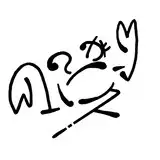
- Formula of the Crab
- My sources are annoyingly Jungian so I’ll have to come back here
- Codex Parisinus
STEPHANOS OF ALEXANDRIA (First half the of the 7th century)
- Probably wrote Great and Sacred Art of the Making of Gold but its alchemy so its contested
- Honestly not super interesting
- Cool Term: tetrasomia. Meaning an alloy of the four base metals
- Basically just experimented with Zosimos theories
ANONYMOUS - 8th or 9th century AD
- The Poem of the Philosopher Theophrastos Upon the Sacred Art
- Influenced by Stephano’s interesting rhetorical style. A compendium of alchemical poetry?
- Weirdly not very interesting
- These poems are fruity af can we get to the islamic polymaths now
KHALID IBN YAZID - 635–c. 704
- YEAHH THERE WE GO
- Secreta Alchymiæ
- A return to hardcore laboratory alchemy
- “Know then my Brother, that this Magistery of our Secret Stone, and this Valuable Art, is a secret of the Secrets of God, which he has hidden with his own People; not revealing it to any, but to such, who as Sons faithfully have deserved it, who have known his Goodness, and Almightiness.” EXHALT AND TRANSCEND
- Azot vive - The Principal of all metals
- A return to the exhalation of metals beneath the earth, and an exploration of what this means for the material world.
- “Beginning now to speak of the Great Work, which they call Alchymie, I shall open the matter without concealing ought, or keeping back any thing, save that which is not fit to be declared: We say then, that the great work contains four Operations, viz. To Dissolve, to Congeal, to make White, and to make Red.”
- There is so much here we are gonna have to come back to him
JABIR IBN HAYYAN / PESUDO-GEBER (8th century)
- GANG GANG GANG
- Like literally, they’re likely groups of thinkers writing under a single name
- Summa perfectionis magisterii,
- Liber de investigatione perfectionis,
- Liber de inventione veritatis,
- Liber fornacum,
- Testamentum Geberi
- We are gonna have to come back here
- SULPHUR MERCURY THEORY
- He’s where we get sophic sulphur and sophic mercury
AVICENNA (c. 980–1037)
- Revolutionized the Exhalation theory
- De Mineralibus
- Acivenna believed that alchemy was “by imitation only”
- Passage that used to be attributed to Aristotle but was actually from Kitˆab al-Shif
- The passage’s notoriety stems from its abrupt rejection of metallic transmutation and contention that alchemists perform only aurifiction, not aurifaction; Nature is decidedly superior to Art
ALBERTUS MAGNUS - 1193? or 1206?–1280
- Taught Thomas Aquinas
- Work is probably spurious
- Albertus follows the popular sulphur-mercury theory
- From Libellus de Alchimia, Ascribed to Albertus Magnus
When pure red sulphur comes into contact with quicksilver in the earth, gold is made in a short or long time, either through the persistence [of the contact] or through decoction of the nature subservient to them. When pure and white sulphur comes into contact with quicksilver in pure earth, then silver is made, which differs from gold in this, that sulphur in gold will be red, whereas in silver it will be white. When, on the other hand, red sulphur, corrupt and burning, comes into contact with quicksilver in the earth, then copper is made, and it does not differ from gold except in this, that in gold it was not corrupt, but here [in copper] it is corrupt. When white sulphur, corrupt and burning, comes into contact with quicksilver in the earth, tin is made, [as is indicated from the fact that] it crackles between the teeth 3 and quickly liquefies, which happens because the quicksilver was not well mixed with the sulphur. When white sulphur, corrupt and burning, comes into contact with quicksilver in foetid earth, iron is made. When sulphur, black and corrupt, comes into contact with quicksilver, lead is made. Aristotle says of this that lead is leprous gold.
- Aristotle [read: Avicenna] “I do not believe that metals can be transmuted unless they are reduced to prime matter, that is, purified of their own corruption by roasting in the fire.”
- MERCURY: An equal mixture of elemental earth and water
- SULPHUR Sulphur, the fatness of the earth, 9 is condensed in minerals of the earth through temperate decoction, (boiling) whereby it hardens and becomes thick; and when hardened it is called sulphur.
- Sublimation: Heating something to a vapor
- Calcination: Burning something to ash
- Coagulation: To heat a liquid in a dry environment until it is solid.
- Fixation: To “temper” a volatile substance in flame until it is non-reactive
- Solution: To dissolve a calcined substance in a liquid
- Distillation: Distillation. To heat something into its liquid form.
- Ceration: To heat a solid substance while gradually adding liquid, usually with the goal of achieving a waxlike substance.
Turba Philosophorum?? Where is that?
ROGER BACON (c. 1219–c. 1292)
- Radix Mundi
- Pushes back on Avicenna “Excellent Discourse of the Admirable Force and Efficacie o Art and Nature by asserting that “Art using Nature for an instrument, is more powerfull then naturall vertue” (from The Mirror of Alchimy, ed. Stanton J. Linden, 49)”
- Red Man and White Wife are common designations for the opposing “principles” of sulphur and mercury that are conjoined in the chemical wedding to produce the philosopher’s stone.
NICHOLAS FLAMEL 1330 - 1417
- His Exposition of the Hieroglyphical Figures
- He name drops Cabala, but I think hes referring to the jewish teaching, as he predates Reuchlin
- Writes about alchemy in flowery biblical metaphor
- Lots of talk about dragons and monsters and journeys, the sort of thing that Jordan Peterson would cum his pants over
BERNARD, ERL OF TREVISAN - late 14th century
- Collectanea Chymica: A Collection of Ten Several Treatises in Chymistry
- Ugh im gonna have to cross reference this with the brill text idk what the fuck this dude is talking about
PARACELSUS (1493–1541)
- Theres our boy
- Pagel’s Paracelsus: An Introduction to Philosophical Medicine in the Era of the Renaissance.
- Oh shit I didn’t know Pagel had a book on Paracelsus
- Oh, different Pagels
FRANCIS ANTHONY (1550–1603)
- Who?
- Oh he was a paracelcian who invented drinkable gold
- Never heard of this guy why is he in this anthology
MICHAEL SEDIVOGIUS - 1566–1636 or 1646
- Dialogue between Mercury, the Alchymist and Nature
- A New Light of Alchymie: Taken out of the fountaine of Nature, and Manuall Experience . . .Written by Micheel Sandivogius
- he was tortured and imprisoned for refusing to give Christian the secret of his transmuting powder
- eventually arriving in Prague at the court of Emperor Rudolf II, the “German Hermes.”
- From Wikipedia: He discovered that air is not a single substance and contains a life-giving substance—later called oxygen—170 years before Scheele's discovery of the element. He correctly identified this 'food of life' with the gas (also oxygen) given off by heating nitre (saltpetre).[1] This substance, the 'central nitre', had a central position in Sendivogius' schema of the universe
- “is acquaintances included John Dee and Edward Kelley. It was thanks to him that King Stephen Báthory agreed to finance their experiments” OH HEY CAMEO
NOTES: DR. SLEDGE FIA LECTURE ON ALCHEMY
https://www.youtube.com/watch?v=DgP983eCRfM&ab_channel=ESOTERICA
Two big misconceptions about alchemy:
- Alchemy was a blundering pseudoscience (humanists rejecting alchemy as gothic and backwards, even fraudulent)(The loss of alchemical knowledge, the reintroduction of the alchemist by romantics as the occult genius)
- Alchemy was entirely psychological (The average alchemist REALLY wanted to make gold. This comes primarily from Mary Anne Atwood (1817-1910), and again from Jung (1907-1986) idea still holds influence in new-age circles.)
Alchemy was proto-experimental-science. Its also not JUST about physical transformation. The idea that something could be studied in isolation would have been unthinkable to Alchemists. They weren’t just looking at a single transformation, but the whole of nature, the mind, god, etc. Thoughts, symbols, plants, animals, the stars, are all connected. It is a holistic theory of everything. The transformation was the most important part.
What was Alchemy?
- Word is a bit of a mystery.
- Al- probably comes from arabic.
- The Egyptian word for egypt was Khem. But also the greek word for chemical was Chymie. Alchemy is the word is like itself, its a bit greek, a bit egyptian, a bit arabic. Probably. Can be humorously translated as “The Egyptian Thing.”
Alchemy is SEVERAL theories of nature around the Creation and Transformation of substances.
Medieval people were worried about alchemists in the same way that we are worried about modern scientists “playing god”.
The production of a universal solvent, a substance that dissolves everything. This was called the Alkahest.
The idea that you can take a chemical to suppress a cold, to take something from the outside to balance the inside, comes directly from the alchemical tradition.
For many alchemists, you had to be morally righteous to transform the world. Can does not mean Should.
PRACTICAL + THEORETICAL
- There were lots of things that overlapped with alchemy. Brewers, cooks, smiths, jewelers, miners, dyers, fullers, assayers, potters, glassmakers, cosmeticians, paintmakers, apothecaries.
- The greeks are gonna ask a question: What is Nature? What is nature most fundamentally? People are gonna argue, publish, and disseminate these debates.
PRACTICAL KNOWLEDGE, COMBINED WITH THEORY, DEFINES A SYSTEMATIC PROGRAM FOR EXPLORING REALITY ITSELF
- Once you’ve got a theory of how the world works, and a way to test those theories, you have a system.
THE ALEXANDRIANS
- Invented distillation, the water bath, and the steam engine. (whiskey and brandy use a bain marie)
- MIRRIAM THE JEWESS, and Cleopatra the Alchemist.
- FORMULA OF THE CRAB: probably the earliest formula for the production of Gold.
THE ISLAMIC WORLD
Its really the islamicate world where Alchemy really hits stride. Many alchemy words are arabic
- Alcohol (al-kohl, the black) elixer (al-iksir), alembic (al-inbiq), Athanor (al-tannour, literally the word for furnace), Azoth (al-zauq, means mercury)
- This is where we get the Sulphur-Mercury theory. (all metals are fundamentally made of sulphur and mercury, and if you seal them up in the right mixture, you get gold. )
- Acids are invented
- Alcohol is distilled
- Jabir Ibn-Hayyan, al-razi, Ibn Sina, probably the authors of the Turba Philosophorum, and the Emerald Tablet.
- As Above, So Below, came from here
THE MEDIEVAL ERA
- Alchemy re-enters europe on Febuary 11th, 1144, with the translation of The Composition of Alchemy. Rapidly spreadys through Europe, forming one of the sparks for the Renaissance.
- BY ART OR BY ARTIFICE: Can you make things by yourself, or are you playing god?
- KEY ALCHEMISTS: Adelard of Bath, Albertus Magnus, Roger Bacon, Villanova, Raymond Lull, Pseudo-Gerber, Bonus John Dastin.
THE GOLDEN AGE OF ALCHEMY
- 16th-17th century
- This was the rise of the Entrepanurial Alchemist. And the infamy of fraud.
- PARACELCUSSSSSS
- Make a crucible with a false bottom.
- THE GOLD PLATED GIBBET
- By the late 17th century, attacks on the old science of aristotle were on all sides, even alchemy was not spared. This is where we get the weird transitional period people call Chymistry.
- Robert Boyle practiced alchemy to the day he died.
- The atom wasnt completely proven until the early 20th century.
THE THEORY OF ALCHEMY
- Its Aristotle. Empedocles stole his theory.
- For fundamental elements
- Two principals: The Masculine and Feminine.
- If everything is made of the same four things in different ratios, you can change the ratios and change the substance.
The Islamic world expands upon this
- The Cold/Moist and the Hot/Dry becomes Mercury and Sulphur.
- The combination of the two, beneath the earth, in some ratio, become metals.
So what the alchemist is trying to do, is recreate these circumstances.
- You get your Egg of Hermes (your hermetically sealed flask)
Simple 12 step program:
- Calcination
- Solution/Dissolution
- Separation
- Conjunction
- Putrefaction
- Congelation
- Cibation
- Sublimation
- Fementation
- Exaltation
- Multiplication
- Projection
The idea being that you can transform one metal into another metal. There was good experimental evidence for this theory. If you take a bath of molten copper sulfate, and drop steel iron into it, it looks like it transforms into copper. Miners noticed this for a long time.
This 12 step theory could be verified with color changes. It would go from Black, to Whtie, to Yellow, and finally to Red.
Immortality was HUGE in chinese alchemy, but NEVER in western alchemy. Thats a sin.
The exact starting substance is extremely varied. As are the symbolic representations.
FROM ALCHEMY TO CHEMISTRY
- Transmutation is impossible, at least in the way that that the alchemists thought of it
- They never gave up!
- All the 12 steps take a MASSIVE amount of chemical knowledge to perform
- Fermentation is hard, developing acids is hard!
- So while they never figured out transmutation, they developed a treasure trove of chemical knowledge.
ENTREPRENEURIAL ALCHEMY
- Late medieval period
- You can tell the prince you can make gold, fail, and get the Gold-Plated-Gibbet.
- So you tell him you can make Glass, Paint, Cosmetics, Alcohol, and crucially, Potassium Nitrate: Gunpowder.
- You can track interest in alchemy by Precious Metal Famines. When the mines dry up, alchemy gets inventive.
- If you have gold and silver, you don’t really need alchemists, do you.
- NEWTONNNNNNNN
- He wrote TEN TIMES as much on alchemy than he did on Science.
- Descartes introduced the idea of radical doubt. You don’t look for evidence. You look for contrary information.
- Folks at the LBNL managed tot ransmute lead into gold