Islamicate Alchemy - 7/March/2024
Added 2024-03-07 17:04:21 +0000 UTCISLAMICATE ALCHEMY
EMERALD TABLET
- Just give us a page on this bad boy maybe
CORUPUS JABIRIANUM (died 806)
- Sulfur Mercury Theory
- Organic Matter
- Proto-Iatrochemistry
- Panacea
- Transmutation of base metals into noble metals
(Alexandrian alchemy created this divide between esoteric and exoteric alchemy. This carries over to the ISlamicate world. Rhazes is the exoteric one, Zadith is the Esoteric one.)
RHAZES (864-935)
- Liber Secretorum
- Exoteric
AL FARABI (873-950)
- Father of islamic Neoplatonism
IBN UMAYL / SENIOR ZADITH (900-960)
- Esoteric Alchemy
- Tabula Chemica
- “Epistola Solis ad Lunam Crescentem” (Translation of an arabic work named Letter of the Sun to the New Moon. By Ibn Umayl.)
- [Transition: Alchemy and mysticism]
AVICENNA (980-1037)
- Book of Remedy
- Denies Transmustation
- Anticipated Iatrochemistry
- [Now lets get mystical]
ISLAMICATE ALCHEMY AND GNOSTICISM
- Brethren of Purity from Basra
- [Transition: Alchemy and philosophy]
ALCHEMY AND ASTROLOGY
- Here’s where we talk about the Secretum Secretorum
- Pesudo-Aristotelian
- [Transition: The SS was hella influential on everyone who came after]
THE BIG FIVE: JABIR IBN-HAYYAN
First and most prolific of the Big Five, Jabir Ibn-Hayyan is the foundation of Islamic alchemy. The man himself probably died around 816, but it was fairly common for one’s students to carry on writing under the name of their departed teacher. As such, more than three thousand texts carry the name Jabir Ibn-Hayyan. This body of work –The Jabirian Corpus– introduces too many new ideas to cover in a text like this, but the most important are the Sulfur Mercury Theory, the introduction of organic matter, full transmutation of base metals into noble metals, and the first inklings of medical applications for alchemy. This collection of ideas are what draw the line between Byzantine alchemy, and Islamic alchemy.
JABIR IBN-HAYYAN: MERCURY-SULFUR THEORY
Jabir introduces two new important concepts: Sophic Mercury, and Sophic Sulfur. (Sophic means “of the philosophers.”) Every physical thing has a Sophic Mercury and a Sophic Sulfur that can be extracted from it. You get sophic mercury by fermenting something. You get sophic sulfur by distilling something down to its essential oil.“
Let us play alchemist for a moment. Let’s say you have a rose, and you want to extract its sophic mercury. You would seal it in a vessel to ferment down to a spirit. (As in an alcoholic spirit.) The fluid left over would be some form of ethyl alcohol, but the alchemists would call it something like “spirit of rose” or “sophic mercury.” If you want to extract some sophic sulfur of rose, you would put the flower in an oil still, and distill it down to rose essential oil.
But hey, that sophic mercury seems real similar to other plant sophic mercuries. If you reduce down any flower, you’re probably gonna end up with some sort of ethyl alcohol. Arab alchemists noticed this, and thought “well then, this spirit must be a shared, common essence to all plants. What we have here is a jar of plant-ness.” The same thing happened for essential oils. Arab alchemists noticed “well hey, this rose juice still smells quite strongly of rose. This essence must be a distilled form of rose-ness.”
To Arab alchemists, sophic mercury was what made substances similar, and sophic sulfur was what made substances unique. Theoretically, you could mix-and-match mercuries and sulfurs to “breed” new substances. (Mercury is often referred to as feminine, and sulfur as masculine.)
(Learned readers may be expecting a discussion of sophic salt here, but that doesn’t show up until Paracelsus. Give it a few centuries.)
JABIR IBN-HAYYAN: ORGANIC ALCHEMY
The One-Hundred and Twelve Books (of which only thirty survive) are a series of short, vaguely-related treatises on alchemy. A notable innovation here is the introduction of organic materials like plant and animal products. To many previous alchemists, the human body was higher on the divine ladder of being than things like rocks and stones. Of course it was, we have things like language, and an immortal soul. Rocks don’t have those things. The idea that something as special as the human body would be subject to the exact same rules as lowly lumps of metal was a dramatic change from established alchemical logic.
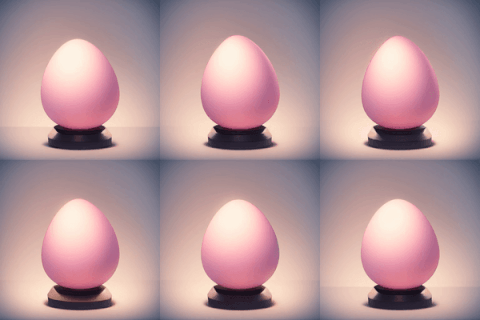
Previously, the closest alchemists would get to living tissue was old eggshells. Now, alchemists were theorizing about the alchemical effects of all sorts of plants and fluids. This was a significant paradigm shift for alchemy. Now semen could be involved. Which was important. Don’t laugh. It was important. This was one of the first steps alchemy took towards iatrochemistry, the idea of using alchemy to cure disease.
JABIR IBN-HAYYAN: PANACEA
JABIR IBN-HAYYAN: TRANSMUTATION
Comments
Do you ever codify the close-as-makes-no-nevermind finished essays into documents?
Trey
2024-03-08 05:21:33 +0000 UTC