Maggie's Farm (James Benning, 2020)
Added 2020-07-07 18:20:39 +0000 UTC
Well, I wake up in the morning
Fold my hands and pray for rain
I got a head full of ideas
That are drivin' me insane
It's a shame
The way she makes me
Scrub the floor
The later works of James Benning represent exercises in "deep looking," in much the same way that Pauline Oliveros's music was meant to inspire deep listening. Many of the films Benning has made since turning to digital imagemaking have pushed the boundaries of conventional film time, asking us to sit with spaces and sites that initially look utterly static. It is as if we are watching photographs or paintings assemble themselves in time, and the more closely we look, the more the tiny details jump out at us: a branch blowing in the wind, or a small car rushing by in the background, or a slight change in the sunlight.
This stillness has been an element in Benning's work for decades now, something we've seen in the California Trilogy (2000-2001), 13 Lakes (2004), and Ten Skies (2004). But the filmmaker has taken it to greater and greater extremes in recent years, resulting in single-shot landscape films where change within the frame is so attenuated as to practically require the viewer to enter a fugue state to fully observe it. The clearest example is 2013's BNSF, a 3-hour shot of a stationary train, but even the 1-hour L.COHEN (2017), which is notable for one single "event," is a test of most viewers' attention spans.

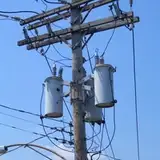
Maggie's Farm is just under 90 minutes and consists of 24 shots, each one about 3 1/2 minutes long. The camera is fixed, and apart from the occasional soft breeze or insect flying in front of the lens, there is no movement. We hear the ambient white noise of the outdoors, and the nearby highway, in the exterior shots. In the interiors, we hear almost total silence. This is a film shot in and around Benning's place of work, the California Institute of the Arts, in Valencia. Apart from a few cars in the background of the first shot, we see no real evidence of human life. This is the institution, just asserting itself.
There are a few formal aspects of Maggie's Farm that set it apart from recent Benning films. For one thing, this is the most elegantly composed film he has made in quite some time. The use of medium shots throughout Maggie's Farm really allows Benning's sense of photographic framing to come through in a striking way, such that we are not left simply watching time unfold. We are observing the act of extracting "views" from otherwise ordinary spaces, and then seeing those views unfold across a given span of time.

But going from the grounds to the inside of the CalArts buildings has the effect of making those halls feel almost oppressively antiseptic, as though we suddenly entered an audiometric chamber. When we exit again, we notice the cheap building materials butting up against otherwise unassuming patches of landscaping, emphasizing the controlled, manicured quality of even that which initially looks "wild." Benning is casting a glance at his own place of work, seeing it as an institutional structure that conditions everything in and around it. (In its own strange way, Maggie's Farm is Benning's "Wiseman film.")
But this all has a particular meaning given the fact we are looking at CalArts. This is a university with a history of exploring its own institutional status. In the art world, CalArts is famous for its Post-Studio course, taught by the late Michael Asher. Thus course, which helped shape generations of conceptual and post-structuralist oriented artists, served to break down traditional ideas of "medium" and "display," to expand the idea of art to include philosophical ideas about objecthood and social change. Asher's own work entailed interventions into the gallery or museum space -- removing walls, generating blasts of air, manipulating sound -- that disrupted the institutional space of exhibition and display.
So in a sense, Maggie's Farm continues Asher's Post-Studio project, by creating a film that is a theoretical dismantling of the institutional conditions of its own making, and of its maker's conditions of employment. If, pace Bob Dylan, Benning "ain't gonna work on Maggie's farm no more," that's only because Benning is altering the definition of "work."