[Background Blog] The Yaoguai Bystanders of Lin & Partners
Added 2020-05-31 15:46:40 +0000 UTCFor this blog about Nekojishi: LIn & Partners we wanted to take a look at some of our recent work into diversifying the NPC variety in the game and give people a little peek into some of the designs and a bit of the modelling process!
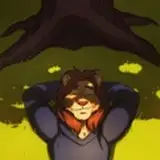
While less common than humans, in Lin & Partners Liao will also see yaoguai bystanders mulling about in different scenes. Our character modeller, Lenz, came up with a few different designs, each with different clothes and fur options to give more variety with the NPC generation.

All our models begin with a high-poly base sculpted in Z-Brush. While the detail of these models may look nice, it’s not really feasible to run models like this in a video game so we have to reduce the complexity from hundreds of thousands of polygons to thousands to get decent performance in real-time.

While a lot of details are removed through this process, it makes it possible to run these models in real-time in big scenes with lots of other geometry in place. In this case, the models are brought down to around 5k-6k polygons, which is about 2k less than the average story NPC. (The parts sticking out of the model above are indicators of the animation bones in the model.)

However, there’s still a lot we can do to reduce the amount of visual fidelity lost in the models. For example, smaller details are baked into different textures such as normal maps and AO (ambient occlusion) maps. These textures alter how different regions of the models are lit to give the impression of more detail, such as a rounded edge, or a crease in some clothing.
More non-geometrical detail is also stored into different textures. Of course when you think of a texture, you think about the image that’s applied to colour the different areas of a model, but you also have material textures, such as the metallic/roughness map which determines how reflective different areas of a model are. (Such as in the case of scales vs fur, or pieces of metal on clothing)

And all of this then comes together to reach to the final models in-engine! There’s a little more detail we can go into the modelling and shading techniques but those are better off written up into their own blogs. In any case, we hope you enjoyed this little overview into the different stages of modelling and getting models ready for use in-game. Be sure to say hi if you see them around!
- Studio Klondike