There are so many Cups now its hard to keep track, even crazier that they all seemed to be happening within 30 days of one another (you organizers need to work on that, haha) but I'd be remiss if I didn't comment on the latest event, the first "Island Cup" with HPLC testing by Jordan Jacobs at TrypLabs.
For what its worth, Jordan now thinks it was a mistake to call this a "Cup" and he wants to remove the "competition" aspect from it in the future and will not be calling it a Cup next time. Prizes were actually awarded randomly and not based on any particular testing result, and he prefers to think of it as a community data collection event. Another interesting aspect was that, in an effort to collect data on less common species, it was totally FREE to enter any species other than cubes, pan cyan, natalensis and tampanensis. This seems to have encouraged a bunch of submissions that haven't appeared in other testing events, indeed 18 different species were represented, making this event unique. Jordan tells me he hopes that in the future the cost of the HPLC testing will be covered by sponsors so that ALL entries could be free (that would be pretty amazing for the community).
These results are obviously coming from a different lab compared to past HPLC testing results that I've commented on. Each lab does things a little bit differently and works with slightly different hardware. In a perfect world they would all be getting similar results, but in the testing world there seem to be some labs that test higher than others. I noticed that many of the results were on the higher end of what has been previously reported by other labs for similar samples, so that is just something to keep in mind (I'd love to see outlier results from any of these testing events sent to multiple other labs for further review).
Anyway, there were 75 samples tested in this event, with a very wide range of potencies going from nearly 0 all the way to a whopping 5.17% PCBE

The most potent sample? I bet you can guess... 😂 our beloved pan cyan "TTBVI" coming in at an insane 5.17% PCBE (submitted by a patron here who goes by "Altered Vibes"):

(if you want to know the story about where these super potent genetics came from, who originally collected them from the wild, and what TTBVI stands for, I wrote up it's origin story here also note that any patron that would like a free spore print can private message me here on patreon). This marks the 5th consecutive win by TTBVI for most potent cultivar in the known world (2x winner of the Cultivar Cup, winner of the Denver Psychedelic Cup, winner of the Michigan Entheo Cup and now winner of the Island Cup - someone please send it to the Hyphae Cup so we can round out a clean sweep of every single cup, haha).
It is interesting to note that the person who submitted the top potency TTBVI sample, "Altered Vibez", says he pretty much just followed the standard TEKs, did not use special substrate ingredients, nor did he do any special isolations, BUT he did do one thing of interest. He revealed that to dry his sample, he put them into a normal food dehydrator BUT he had removed the heating element, and dried them slowly for 2 days (48 hours) before finish drying them with desiccant in a sealed chamber. This is of renewed interest to me because recently I've seen other reports of low temp drying or room temp drying resulting in higher total alkaloids. For example here is a recent graph from one of MagicMyco's clients' experiments:

In this case "Air Dried" was the clear winner, he described it as "in my dry room so sitting at 90F (32C) on an herb drying rack with a dehumidifier and fan and heater in the room". Ironically, decades ago it was quite common for people to do long slow drying using desiccant and fans at room temp, it was widely believed that heat would destroy the alkaloids, but then more and more people slowly discovered that higher temp food dehydrators were super convenient, fast, and the finished cracker dry results were still potent so the consensus slowly shifted to food dehydrators being the preferred and recommended approach. I hate to say it, but its possible that the old slow methods of super low temp drying may actually be best when it comes to absolute optimal alkaloid preservation but I don't want anyone to leap to conclusions just yet, this is something I would like to pursue with more extensive careful, scientific investigation. Also, even if there is a slight advantage in preserving alkaloids with the long low temp drying, it may still be preferable to use a higher temp, fast, food dehydrator for other reasons (I personally don't really want to spend days doing drying). In other words, most people may not care about squeezing out every last bit of potency if it means sacrificing convenience.
There are some other interesting things to note from the Island Cup data release and there may be more to learn later as they did not release the meta data yet that would include things like substrate ingredients and growing and drying techniques.

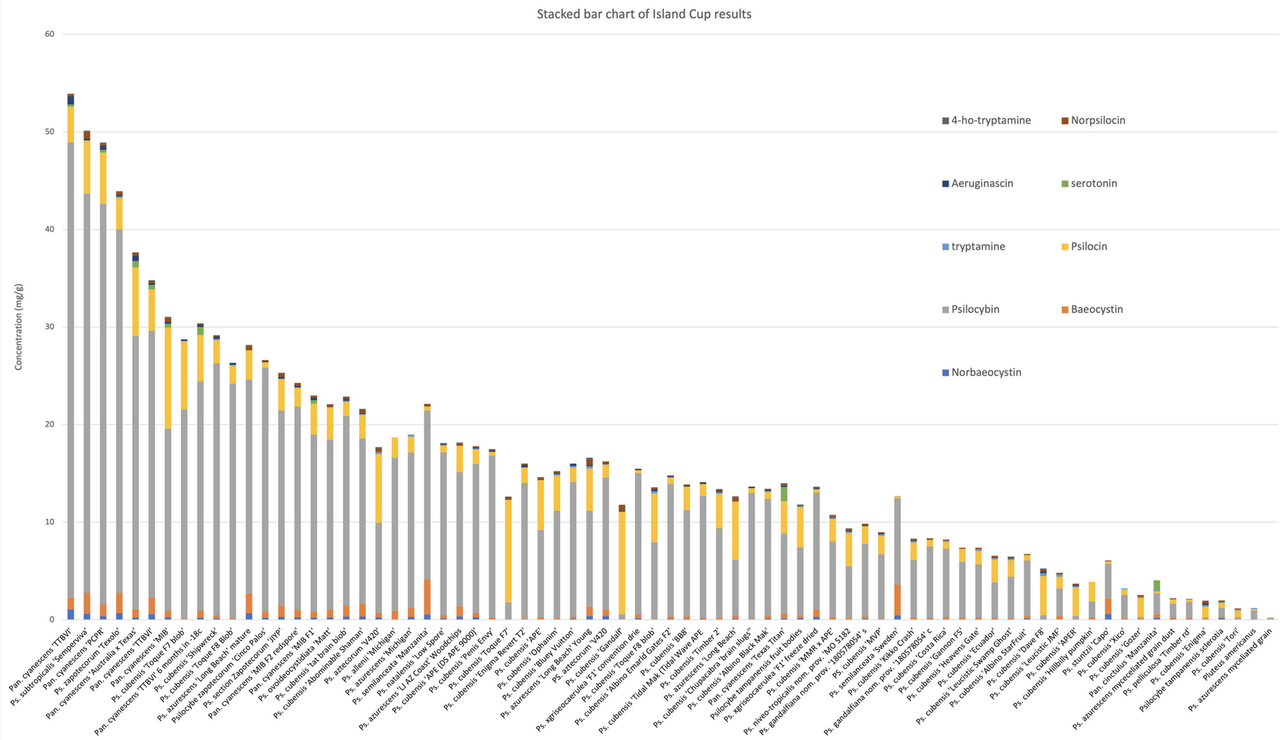
(Link for bigger image) One thing that stands out in the alkaloid bar chart from all entries is the relatively huge amounts of baeocystin found in the Psilocybe semilanceata (commonly known as the liberty cap) samples. User experience reports for that species are generally positive, so this is one distinguishing feature of the species that could perhaps explain why the experience may be different despite the fact that we don't have much reason to believe baeocystin plays a significant role in one's user experience (but as mentioned before this article has more details including an interesting theory that "baeocystin could potentially exert a synergistic effect with psilocin/psilocybin by competing for MAO, effectively increasing psilocin concentration in the blood").
Someone sent in two samples of Psilocybe azurescens myceliated grain spawn:

But these tested at just 0.2% and 0.03% PCBE so barely even psychoactive. The allure of extracting alkaloids from myceliated grains resurfaces every few years, but I find it a less-than-ideal approach. Sure, it's technically possible, but Pan Cyans offer a clear advantage. With Pan Cyans, you can slash the cultivation time to under 30 days while achieving significantly higher potency – colonized grains take a whopping 60 days to reach their peak potency and they remain pretty low in alkaloids even at peak. On top of that, storing grains at room temperature for months introduces potential quality problems. From my perspective, the idea is a dead end.

There was one Psilocybe tampanensis sclerotia sample, and once again this species came in super weak at 0.16% PCBE.

The biggest surprise from the Island Cup might have been a Psilocybe subtropicalis testing at a whopping 4.85% PCBE. There have long been rumors of this species being a contender for most potent, but I've never seen a sample test above 3% until the Island Cup (see my previous research notes on subtropicalis here). When I had mine tested it was a respectable 2.37% PCBE but there were two subtrop entries to the recent Denver Psychedelic Cup that both tested quite weak at 1.05% and 0.85%. That said, the fresh subtropicalis mushrooms I bioassayed were quite potent and it remains a species of interest to me. It seems there are many distinct cultivars of subtropicalis and some are far different from others in both potency and growing characteristics. I am currently researching additional cultivars of this species.

Another surprise was a Psilocybe zapotecorum 'Texolo' sample testing at 4.17% PCBE so now we actually have two close runner ups for most potent species. Again, I have never seen this species test above 3% before this Island Cup. For both the Zaps and Subtropicalis I'd love to see other labs confirm these outlier high numbers.

The most potent cube in this event was 'Toque F7 blob' coming in at a very impressive 3.1% PCBE. A similar genetic line was also the most potent cube in the recent Denver Psychedelic cup where it tested at 2.8%. Both were mutant/blobs and not normal mushroom fruit bodies.

There was just one natalensis sample in the Island Cup, a special low spore isolate that tested at 1.77% PCBE which is the highest result I can remember ever seeing for this species. Of the 15 natalensis samples submitted to the recent Denver psychedelic cup, not a single one tested above 0.9% and the average was just 0.6% (my own samples have tested as high as 1.2%). Regardless, anecdotes are very positive for this species and it remains of great interest to me, I continue to research this species and will publish more about it in the future including a full length video that I am currently working on. If any patrons want a natalensis spore print, message me, I have plenty to share (for free). It is very easy to grow and can be grown just like cubes, in unmodified totes. Casing layer is optional but recommended.
We are still very early in the discovery of interesting cultivars within most species. Many species don't even have named cultivars yet. Discoveries of very high potency isolations in almost any species really, should not be a surprise. There are likely certain mutations that contribute to potency and the same mutations can occur in any species that synthesizes psilocybin. Cubes used to average pretty weak too, and now new potent cultivars are popping up frequently. I'm more interested in consistency personally, for safety and reproducibility purposes (for example if a person grows X cultivar exactly following some TEK and harvests at a specific point in the growth, and dries a specific way, and homogenizes the result, they should have some relatively tight range of expected potency.

The final item of interest to me from the Island Cup was an older TTBVI sample that had been stored in a sealed glass jar on argon for 6 months in a freezer at -18C (0°F), it tested above 3% which is quite impressive and another great data point for long term storage. In this follow up after 6 months in freezer storage, the psilocybin level had only dropped by 25% from its original test value, this was SUPERIOR to the samples stored at room temperature in terms of psilocybin, but interestingly, the overall potency preservation was superior in the samples stored at room temperature, meaning while more of the psilocybin was destroyed at room temp, the psilocin seemed to be preserved better at room temps (psilocybin becomes psilocin when it deteriorates). Overall there was a 19% loss of potency after 6 months stored in a freezer (compared to my previously published results where there was less than 5% loss of potency when stored at room temps for 4 months despite the majority of psilocybin being destroyed in that timeframe). While this result essentially confirms the belief that storing at room temperature may be superior to storing in a freezer which was reported in a published study the fact that psilocybin was much better preserved in the Island Cup sample compared to this published study suggests that this idea should definitely be reexamined. Science is self correcting, and when there is only one study on a particular matter, you really haven't established anything.
(Ref: Gotvaldová K, Hájková K, Borovička J, Jurok R, Cihlářová P, Kuchař M. Stability of psilocybin and its four analogs in the biomass of the psychotropic mushroom Psilocybe cubensis. Drug Test Anal. 2021 Feb;13(2):439-446. doi: 10.1002/dta.2950. Epub 2020 Nov 4. PMID: 33119971)
______________________________________
We are still very early in the discovery of interesting cultivars within most species. Many species don't even have named cultivars yet. So is not surprising that there would be discoveries of very high potency isolations in almost any species really. Cubes used to average pretty weak too, and now the potent cultivars are popping up frequently. I'm more interested in consistency personally, for safety and reproducibility purposes (for example if a person grows X cultivar exactly following some TEK and harvests at a specific point in the growth, and dries a specific way, and homogenizes the result, they should have some relatively tight range of expected potency.
Gary
2024-03-05 23:05:39 +0000 UTCHerbert Suede
2024-01-30 23:25:32 +0000 UTC2high2flyfpv
2024-01-08 15:37:07 +0000 UTCMiguel
2023-12-20 19:10:24 +0000 UTCAltered Vibez
2023-12-14 20:44:31 +0000 UTCMountain Myco
2023-12-14 16:00:25 +0000 UTCGordoTEK
2023-12-14 15:59:15 +0000 UTCBlueJay
2023-12-14 15:55:43 +0000 UTCGordoTEK
2023-12-14 15:45:46 +0000 UTCGordoTEK
2023-12-14 15:42:02 +0000 UTCGordoTEK
2023-12-14 15:33:20 +0000 UTCAltered Vibez
2023-12-14 12:22:22 +0000 UTCBlueJay
2023-12-14 02:10:58 +0000 UTCBlueJay
2023-12-14 02:09:37 +0000 UTCBrian Place
2023-12-14 00:18:03 +0000 UTCJerry Nile ODell
2023-12-13 16:14:40 +0000 UTCGordoTEK
2023-12-13 14:29:48 +0000 UTCGordoTEK
2023-12-13 14:24:20 +0000 UTCWillyJak27
2023-12-13 13:23:09 +0000 UTCMagicMyco
2023-12-13 07:29:07 +0000 UTCLearn More
2023-12-13 04:50:10 +0000 UTCLearn More
2023-12-13 04:47:18 +0000 UTCTony Hansen
2023-12-13 04:44:00 +0000 UTC