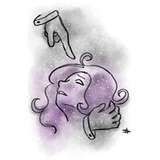
Hypnomancy: How to Read Your Partner Like a Tarot Card
Added 2021-02-05 20:23:50 +0000 UTCI have been thinking for some time now about the parallels between the way that I practice hypnosis and the way that I have practiced different elements of magic. I’ve talked before about the role of ritual and symbolism in both -- the way that we assign power to concepts behind words, through metaphor and allegory. The motivations of seeking power or play. Even for someone like me, who does not really believe in a magical power greater than myself, magical ritual is rich with expressive potential and is something I return back to, especially because of the correlations I feel exist within hypnosis.
I was struck recently by this feeling I had while reading tarot a while back -- reading the card kicked up some trance anchors for me. Of course anything so heavily introspective would be hypnotic, but I had this vivid feeling and idea -- how gorgeously romantic and erotic is the concept of reading someone or being read as a tarot card? And I realized that there was already a lot that I already do that is not far from this.
This writing is a conceptual exercise and one that I’m excited to explore -- I think the more we’re able to create metaphors that make sense to us in terms of the nature of hypnosis as an intimate act, the better we get at doing it with partners. We gain resources in how to talk about it and perform it. Let’s see where this one takes us.
Variety in Interpreting Tarot
There is no singular method to reading tarot cards -- there are a variety of ways that practitioners approach every aspect of this, from preparation, to choosing, to ultimately going to interpret. And it is not just that there are different methods; the context itself that someone is coming from informs the way that they look at tarot as a whole.
For some, tarot is necessarily spiritual. The reader is allowing some force to send them messages, whether that is some kind of divinity or spirit presence, or a personification of the deck itself. For others, tarot is more psychological -- simply a vehicle for discovery, where all of the useful information comes from inside oneself. This can be simplified into one of the biggest questions of someone’s practice: is it internal, or external -- or a bit of both?
To better understand some of the ways that tarot reading can vary, we’ll look at two theoretical examples. To keep this more simple for now, both readings will be only involving one person and a single card.
Reading 1:
One person is seeking answers about what they should focus on in terms of their self-care needs. They are a witch, and they keep their deck on their altar to charge. To begin, they have a ritual -- they light a candle and use it to get into a meditative place, opening themselves up to their higher power and forces of magic. They place their hand on the deck box to connect themselves with it and whisper a request that they would be shown something useful. Lastly, they drip wax on the box to ritualistically transfer the energy. By this point, they have gotten themselves into a place where they feel able to receive answers in an unbiased way; tranquil and emotionally grounded and blank.
They remove the cards from the box and focus their attention on their question. They let their hand move automatically as it cuts the cards, then they shuffle and fan the deck. They wait a moment to see if any of the cards are calling to them -- one feels magnetic, so they gently touch it and refocus on their question before drawing it and flipping it over.
It is the Five of Pentacles. They know that this card has implications of insecurity, alienation, and unwellness, but also support. They turn to their sense of openness and allow themselves to think about what message they are receiving -- the suit of pentacles might imply something about money, and the imagery on the card shows two people. The fact that these things jumped out at them tells them that that might be significant: in regards to their query about self-care, it could be a reminder that they are not alone, and either a warning to be cautious financially or that they may want to spend a bit of extra money to make themselves happy. Is there a challenge in that? Something that they may need to think hard about for themselves, a choice they need to make?
They quietly thank the cards and spirits for showing this to them, place the deck back on their altar, re-center themselves and blow out the candle.
Reading 2:
Another person is doing a single-card reading with nothing specific in mind -- simply looking for something that could have meaning about their day. They are not a particularly spiritual person. They open the tarot app on their phone and go to the deck. They think briefly about their situation for the day -- some quiet time doing work and no plans for the evening. They wonder about what kinds of questions that brings up.
They tap the deck and a card is drawn -- the Five of Pentacles. This person only has some card and symbol meanings memorized, and this is a new one to them, so they study the image. The pentacle symbols appear to be encased in a stained-glass window on what seems like a church. There are two figures walking in the snow in front of it, one on crutches following another bundled in a brown shawl.
They turn their attention inwards and think broadly about what this card could mean. It certainly doesn’t seem like a wholly positive situation, but the fact that they see the unhappy people going to a church makes them think about the role of spirituality or religion as something that is comforting and healing to people. They reflect on the idea that they are using a generally-spiritual thing (tarot) to bring them some form of solace -- were they uncomfortable before? They think about their day, what they have coming up, and consider that if they are feeling a bit unwell, they may want to find peace in something that is similarly broadly comforting. They notice the stained glass and snow -- two things that are specifically relevant to their situation (having yesterday done stained glasswork in Minecraft and today expecting snow in the evening), and wonder if there is another pattern -- the fact that there are two figures then reminds them that one of their friends is having a rough time, perhaps reminds them to give them some gentle attention or care.
They keep these things in mind, and close the app.
These are two distinctly different methods of reading cards -- to some degree, polar opposites, but even these do not represent both “ends of the spectrum,” which would be an impossible task. As we go through the rest of this writing, we’ll talk about pieces from both approaches, but perhaps more largely geared toward this second idea of internal processing. That being said, it’s likely that when we start to incorporate this kind of thing into hypnotic practice, if someone already has a particular way that they read tarot, their own process will be particularly fulfilling for them in terms of translating this to hypnokink -- not completely copying someone else’s methods.
Breaking Down Commonalities
All of this being said, while there is quite a bit of variance, we can notice some general similarities between the two here (and in tarot reading as a whole).
Firstly, there is ritual. In a magical context, this idea of ritual is obvious, and corresponds to some kind of action taken that is specifically symbolic and repeated. But even outside of this scope, we can think of the idea of approaching tarot in any way as ritualistic. How we store and retrieve the cards, how we shuffle them, how we draw them. Ritual is about a prescribed order, and tarot often follows an order in and of itself, even if the methods change. Question, shuffle, draw, interpret.
Secondly, there is some quality of a change in focus. Some people who use tarot intentionally enter a meditative or altered state in order to better read the cards, but even broadly, some kind of change in attention and awareness is said to be an important ingredient in tarot. People do this in all sorts of different ways -- sometimes there is focus on the cards, focus on the information they’re looking for, focus outside themselves, or any number of things. Often there is a particular quality of attention that develops when reading cards, a headspace that someone might get into.
Thirdly, there exists some attempt to gather information about the situation at hand. One of the attention shifts that someone reading tarot does has to do specifically with trying to understand what is happening. There has to be some comprehension of what their situation is in order to ask questions or seek information about it. This may be introspection or focus outwards to have a broad sense of what they need to reflect a solution or commentary on what they are experiencing. This connects also to an intense emphasis on observation, both of the situation, and of the cards themselves.
Finally, there is a process of looking for patterns and connections. This is the “interpretation” part of tarot, where a simple card needs to be transformed into an abstract answer. Humans are naturally inclined to look for patterns in our lives, and this tendency comes to the forefront when we look at tarot. Some readers place a lot of importance on the commonly accepted meanings of the cards, while others rely more on looking at them in the moment. Symbolism is an important part of the way that we communicate, and we make associations with colors, shapes, depictions, suits, numbers -- all aspects of the cards. It is the process of us making a connection between our question or situation and the seemingly innocuous elements in front of us. We do this based on the ways that we organize information and thoughts, and attempt to derive meaning from symbols and metaphors -- just like we might do when reading a story or listening to someone talk.
The Hypnotic Method Through the Lens of Tarot
We can use the concept of reading tarot as a metaphor for hypnosis. Realistically, when we discuss how to do hypnosis, we’re always talking about it through some kind of model -- a framework for how it works. If we change our model to be about the kind of interpretation we do when looking at cards, we can see a lot of parallels. As the hypnotist, you’re the reader, and your partner is the card.
Hypnosis is ritualistic, much the same as tarot. Many methods outline a structure for how hypnosis works -- usually beginning with pretalk or negotiation. But even rejecting that structure, within an intimate partnership, we usually have little rituals that we go through with each other. The engagement often follows some form -- getting on a video call and saying hello, sitting down with each other and giving a look, changing the way that we speak to signal that we’re doing trance, getting into the zone, or even a particular pattern of words that we use. All of these small practices can be seen as a ritual, and especially as we grow with our partners, we can understand them to be an important, nuanced part of our shared grammar and experience. Each part of a hypnotic scene has elements that we can consider rituals, especially when we give them significance by acknowledging that.
When we engage in trance, we as the hypnotists often get into our own space. We shift focus in a particular way such that our attention on our partners becomes something important to the trance itself. We are observing to the point that we often go into trance ourselves, something that many of us can distinctly feel. Sometimes that hyperfocus is on our partners, and sometimes it is on how we are feeling and what we are thinking -- what are we going to do or say next? How is the person responding? What changes do we notice in body language or tone, and what is that saying to us about what we are feeling? The quality of attention that we feel when we shift our focus to be so narrow and so intent is incredibly similar to the feeling of focus on a card to interpret it.
Indeed, gathering information is universally important to the hypnotist. Utilization is often cited as a critical part of hypnosis -- the idea that we should be understanding as much information about our partners as we can in order to use it hypnotically. It matters that the subject feels seen, but even more than that, it’s about understanding their personal history and how it relates to us in this moment -- just like how we strive to understand our situation and the cards we encounter to gain answers in tarot.
And similarly to tarot, hypnosis at its core is all about being able to see and create associations. We can conceptualize hypnotizing someone as an exercise in viewing and explaining patterns to someone. In order for a subject to buy-in to hypnosis and be hypnotized, part of our job is about getting them from point A to point B, and we do this by selling them on how to get there. Why are they going to go into trance for us? How will they know when they feel it? How do we connect that with other things we want to make them feel? If we start an induction by talking about their body relaxing, what paths do we have available to get to them being in trance? We come up with these connections through a combination of introspection and observation. To some degree, hypnosis is about being able to think about a concept and understand the way it relates to other concepts -- this gives us options. If we want to make someone dumb, we might consider all of the things that dumbness relates to -- stereotypes, kinesthetic feelings of their mind not working right, experiences someone has had that made them feel dumb, colors, thought patterns, anything. If we think about a word we are using, what implications does that word carry? If we think of a synonym for that word, how do its connotations change? How do those things connect with our partner, and the complicated web that they themselves are?
And even moreso, it’s not just the patterns we notice in our own hypnotic patter, but the patterns we notice in our partners’ responses. We develop an understanding of their nuanced “language” -- when they breathe like that, when their eyes flutter in that way, what does it mean? In the same way that we might say reading a new deck takes practice, each individual subject has their own language that they show us. It is about deriving meaning from someone’s responses, and then learning how that meaning connects with our current situation -- the trance, the partnership, the topic, etc. This is a crucial aspect of hypnosis -- Georg Barkas, rope educator, has framed the idea of a scene as a series of “questions” that the top asks the bottom. These questions are the actions that we take as the top -- any act of engagement is a query that the bottom answers with their responses, and a scene effectively takes the form of a sort of interview, a back and forth conversation. This is relevant to hypnosis in general but especially when we are relating to tarot -- we are seeking “answers” from our partners the same way we seek answers from the cards: by careful observation, understanding, study, and interpretation.
Objectification and Romance
Now that we have a model for the way that hypnosis connects to tarot, we can further extrapolate to some interesting applications. We can think even more literally about what it might mean to read someone like a tarot card, and the kinds of kinky play we can engage in.
One of the first concepts that jumps out is the idea that if we are viewing our partner as a card, as something to be read, we are objectifying them on some level. This could be a sort of metaphorical sense of objectification, where their responses are the only important part of them. Or it could be something more literal, where some kind of transformation occurs, with any of the fun tricks like making them very still, having their thoughts freeze or become segmented, losing their opinions, or taking on any number of qualities that an object may have.
In objectifying someone, there is a shift in perspective in one or both parties. The objectified partner may see themselves or you differently -- they begin thinking of themselves as a “thing” of some sort. One of the most common contexts for this is a thing that is used; there is motivation to be useful (or lack of motivation, just detachment and base knowledge of being useful). In being read as a tarot card, the “use” of them might vary as we’ll talk about, but largely they are playing some role of giving information or being open so as to be understood -- both important ingredients in hypnosis. You can encourage the way they see themselves as a tool to be interpreted, perhaps amplifying their sense of how they respond. Or removing it: what if they can’t pay any attention to their own responses, so they happen more unconsciously?
Your perspective may shift as well; in order to objectify someone, you need to see them a little differently. The way that you place importance on their different actions and responses may change. This may be a familiar headspace to you as the hypnotist, or it might be something you need to learn over time. Sometimes this is about a sense of entitlement to various aspects of someone, like the way that you deserve their responsiveness. It could also be about paying less attention or placing less emphasis on them or the way that they feel about things.
Objectification can be about downplaying the person’s sense of self or importance, or it can be about emphasizing it. An object can be rarely thought of, or it can be seen as precious. In the tarot metaphor, we have a unique opportunity to highlight how valuable our partner is -- a tarot deck is often seen as a significant item, at times even revered. This provides us with a chance to romanticize this connection -- your partner is a special thing with special qualities, serving a beautiful purpose. In magic, the practitioner often has a connection with their tools, and this is a relationship you can draw upon when you objectify your partner in this way. You might consider other magical metaphors -- for example, your partner being a sort of familiar: deeply coupled with you and indispensable.
Interpretation
Practicing tarot comes down to the idea of interpretation. Reading the cards is an exercise in intuition and personal exploration, especially in the model we are using when discussing it as analogous to hypnotizing our partners. Carl Jung, famed psychoanalyst, actually had a decent amount to say about tarot -- he posited that, in regards to the cards and their symbolism:
“Those are sort of archetypal ideas, of a differentiated nature, which mingle with the ordinary constituents of the flow of the unconscious, and therefore it is applicable for an intuitive method that has the purpose of understanding the flow of life, possibly even predicting future events, at all events lending itself to the reading of the conditions of the present moment. It is in that way analogous to the I Ching, the Chinese divination method that allows at least a reading of the present condition. You see, man always felt the need of finding an access through the unconscious to the meaning of an actual condition, because there is a sort of correspondence or a likeness between the prevailing condition and the condition of the collective unconscious.”
Essentially, the idea that by looking at the symbols we have collective associations with, we are able to learn things about ourselves, others, and events because of our unconscious understanding. One method of tarot is a sort of therapeutic one -- not therapeutic as in “for healing,” but as in discovering answers from within. In fact, tarot is actually used in some forms of psychotherapy. By reflecting our situation on pictures and symbols that hold previously-established meaning as well as meaning we intuit in the moment, we are able to draw connections and see perspectives that we may not have considered. In the previous examples of reading cards, perhaps the practitioners had not thought of religion or money as somehow important to their situation -- and then that they had, they were able to expand their understanding of what they were considering. We could say that part of this happened unconsciously, because of their gut feelings about the pictures they saw. Those gut feelings came from their personal associations, learned through their lives, as well as collectively understanding cultural symbols.
If we think about this hypnotically, with our partner as a card, they become this collection of archetypal ideas and symbols. When we shift perspective like this, we can start to see their responses as things that we might already carry associations with. What kind of personal or cultural associations do we have with heavy eyes, limpness, gasps, a blank expression? Certainly there are a lot of erotic implications with this kind of imagery, and maybe some introspection reveals things about the way you feel about hypnotic expressiveness, or your partner’s individual responses. Then the key becomes: if I reflect myself onto these responses that I am seeing, what does it tell me? What are my gut feelings? This can be very trance oriented; “I am thinking about dollifying my partner -- what do I see in the way that their arm is resting that reveals how I am feeling about that, or how I might proceed with that?” Perhaps in this situation, you notice the lack of muscle tension and it leads you to think about how loose and floppy a doll could be.
Intuitive tarot reading is quite a bit about imagery. There is a particular method that some find useful, where the reader imagines themselves “going into” the card -- envisioning what is happening inside it and thinking about what story is being told. The singular symbols themselves are significant, but the whole of a card -- or in this case, a subject -- is a collection of symbols and that can be emotive. Sometimes, we notice individual responses that seem significant to us in hypnosis; often when something is a new response or when something changes in the moment, because it jumps out at us. But it is also good to sometimes take a step back and look at all aspects of what you are seeing. Zoom out and ask yourself what vibe you are getting from their whole being, them as a collection of responses. What is your connection with this image of them?
There is a novelty of reading a living, dynamic person instead of a static card. The fact that we tend to notice changes rather than the whole, the idea that in each moment they may have a different response. In a hypnotic scene, there is a back-and-forth of these interactions, constantly. As Barkas says, you are asking a series of questions, and they are answering. So your partner changes based on the information and environment you are giving them at any moment.
Hypnotic Divination
Over time, we tend to calibrate to our partners -- we more unconsciously understand their responses as meaning certain things relative to how they are feeling. In the tarot metaphor, we add an extra layer to this calibration: we start to understand their responses as meaning certain things relative to how we are feeling. When we expand this to more “divination,” further using this more than as simply a model for intimate hypnosis (which is quite useful -- we are “divining” within and about the partnership to begin with), this new connection becomes important. After all, we are using our partners as a way to be introspective about a situation that we are asking questions about ourselves. Again, it is this idea of reflection -- attempting to learn about something personal by bouncing it off of something else with vivid symbolism.
You could certainly think of tarot imagery itself here, if that’s something you’re familiar with and interested in: is the way they are sitting reminiscent of The Empress card? Are you reminded of the dogs in The Moon because of how they are breathing? Do their closed eyes remind you of the blindfolded figure in the Two of Swords? What kinds of associations do you have with the different responses they make and the tarot symbols, or the archetypes that those symbols represent?
But perhaps as well there is some way of learning your partner’s responses as their own symbols. For example, perhaps you are entering into a hypnotic divination scene where you are looking to understand more about how you should approach your next day off. You hypnotize your partner in the context of divining through them. They are deep in trance, following your words particularly quickly and closely; could that be somehow related, doing something that is easy for you or following instructions on something? Their fingers twitch; doing something productive with your hands? Their eyes flutter and you think of dreaming; taking a nap, or perhaps doing something creative? As a whole, your partner looks incredibly relaxed; how do you feel about taking the day easy, or does that make you feel like you’d rather do something engaging? As you scan their body, what gut feelings do you have about the questions you are asking yourself? Does a twist of the arm imply that something is difficult, or a “no”? Do their parted lips symbolize speech, or affirmation?
Consider that this kind of trance might benefit from more waiting than you are used to in a trance. As hypnotists, we can sometimes (mistakenly) fear space between words, but this scenario is an especially good one for including some quiet time for both you to focus on interpreting and them to have spontaneous, unconscious responses. You can certainly encourage this as a part of their headspace -- a knowledge that they’ll simmer in deep trance and just let themselves respond naturally, perhaps giving them an anchor to hold onto to feel trance, like a mantra, or a tactile action like gently squeezing their hand to go deeper and become more automatically responsive. (Or perhaps you want them very focused on their responses instead of having them be unconscious, such that each motion feels deliberate, albeit from a hidden source?)
Notice that in the examples given thus far, the interpretation is not about getting direct answers; the interpreter is asking themselves more and more questions. This kind of divination is about discovering options and understanding different scenarios. It is about obscured paths becoming more clear. Having an open mind about what is possible -- not seeking what is right or wrong -- is key.
Ideomotor / Unconscious Responses
One final concept that we should discuss is a concept called ideomotor responses. This refers to what is seemingly an unconscious, reflexive movement by a person in response to them focusing on a singular idea. Historically, this became the subject of study when it was a popular method of communicating with spirits -- pendulum-swinging and the precursor to Ouija boards, for example. Early hypnosis contributors, such as James Braid, explained this phenomenon by discussing that muscle movement can occur independently of conscious volition, and it became a practice integrated with different parts of hypnosis and hypnotherapy. The idea in modern use is that the client or subject can answer yes or no questions with their “unconscious” through reflexive movement.
Ideomotor responses in hypnosis are often performed as such: the subject is put into trance and some effort is made to connect with a part of them outside of their conscious awareness and volition. They are asked to assign “yes,” “no,” and “I’m not sure” to different finger twitches. Usually, they are asked to choose which fingers represent these responses unconsciously, so that the twitches are congruent with what they feel. The hypnotist then asks them yes or no questions, being careful not to lead them to answers. Sometimes, these responses take a bit of time to manifest, so it’s important that the hypnotist is patient. In a therapeutic scenario, this is used either in parts work (where the hypnotist personifies a part of the person to “talk” to to work out some issue) or in a more broad, general sense where the hypnotist is relying on receiving responses that the client themself is potentially unaware of. This ideomotor signalling can also use pendulum swings and automatic writing as well, among other responses.
This kind of activity is seen a lot in a more spiritual frame too, where someone is asked to connect with a power outside themselves and have that “control” those reflexes -- then questions are asked, and answers are received. To some degree, this mirrors the external versus internal perspectives of divination. Both could potentially be used in a hypnotic scene.
We understand that referring to the unconscious mind is a simplification and personification -- there is no singular hidden part of someone that contains answers and opinions and the ability to express them. However, this metaphor can be useful, especially in this context of hypnotic divination. You can easily objectify and use your partner in a more structured way -- instead of broadly interpreting responses, you can assign and agree upon meaning very specifically. This approach might be useful if you are doing erotic hypnosis with a spiritual flavor; perhaps giving them the experience of being possessed by a power or spirits outside of them which you can then ask questions to. Or you could simply turn them into your own sort of automatic answering method -- one option might be that you tune them in very much to your responses, so they become a reflection of your unconscious thoughts, connecting you both very deeply so they become an extension of you. A conduit for your emotions.
You could ask them questions that you’re unsure about how you feel, and the way that they respond would give you information. There’s no way to avoid “bias” in the sense that your partner’s filters will always be involved, but it may be helpful to understand the way that your partner unconsciously views you and thinks about how you would respond to something. This is also similar to making decisions via a coin flip -- one of the most useful aspects of leaving a choice to chance is that when you flip the coin, your gut response to the random outcome tells you something about how you feel about it, deep down.
Ethics-ish Stuff and Other Considerations
The way that you hypnotize someone is a representation of how you are feeling in a given moment, so your partner is naturally responding to your feelings, even if you don’t tell them the question or situation that you are thinking of. Informing them of what you are searching about will naturally make that a focus for them, and you’ll know that their responses will be consciously or unconsciously filtered through this knowledge; it will affect them. If you keep it to yourself, they are starting from a blank slate. Perhaps you want to tell them about the situation as the trance progresses. Different situations may call for different approaches -- there is no right answer except to follow the methods of consent that you practice; you don’t want to objectify or use someone for this as a whole outside their knowledge if that’s not acceptable in your relationship.
Similarly, the topics that you choose or questions you want to interpret are dependent on what is acceptable in the relationship. A lot of questions in tarot are about other people -- how does your partner feel about you focusing on another person while you are hypnotizing them? Especially if it’s a relationship matter; is this uncomfortable for them to be the object of divination about one of your crushes or another partner? Are family matters off limits because of the erotic implications of what you are doing? The only way to know the answers to these questions are to talk to your partner -- so especially in the beginning, it may be prudent to discuss your intended queries with them before engaging.
It is extremely important to remember that this is not therapy -- not for you, not for your partner, and especially not for the two of you as a couple. While tarot cards are something we might turn to when we are having a real, painful problem in our lives, this is not how you should use your partner. This could place a lot of pressure on both of you, and certainly on them to “respond correctly” to help you, and it builds a negative association with trance and hypnokink as a whole, not to mention the potential for reliance on them as an unwitting therapist. This is much better framed as a form of exploratory play.
Sample “Script”
All of this being said, let’s look at a sample, fictional interaction to see all of the pieces we’ve discussed thus far put into practice, so we can have a more concrete understanding of how this might play out in a hypnotic partnership.
(A hypnotist and subject are spending the evening together. They’re very happy to see one another and want to play, but are not sure where they want to start or what they want to do. The hypnotist suggests doing hypnotic divination with them to come up with ideas and see if there’s anything that comes to them unconsciously. The subject excitedly agrees.)
Hypnotist: Alright, love, we’re going to get you really nice and deep for me so I can use you. You like being used, right?
Subject: Um, yeah…
H: Right? It’s such a nice feeling to let everything else go, all of that stuff about you as a person sort of fading into the background for you to focus on what’s really important right now; the way you feel about me, the way you want to offer parts of yourself that can give me things that are unique to you…
(The subject is breathing a little heavier, and their eyes are starting to get a little glassy.)
H: And it really is all about focus, isn’t it? And I’m causing you to shift focus right now as you start going into deep trance. Controlling your focus is a part of the way that I control you. And making more and more parts of you focus on how I’m going to use you, even if you don’t necessarily know exactly what’s going to happen, makes you so well-suited for this exact thing, knowing that you don’t have to do anything specific to make it “work,” knowing that anything you do is useful for me in this moment, any response you have. Because that’s what we’re doing here, right?
(The subject gives a little sigh, which the hypnotist understands is a sort of accepting response to their suggestion -- both from context in this moment as well as past sessions. The hypnotist is already thinking about what that would mean in response to a question; something affirmative?)
H: And as you go deeper into this trance, this trance specifically, that you are going deeper into right now, you have this knowledge of what we are using you for; you’re going to be a gorgeous little divination tool for me, and just the simple knowledge of that shifts the way that you respond. It takes your willpower out of your body, simply by understanding that, like your consciousness is being evaporated by that sense that you’ll be read and interpreted. You feel yourself detaching from your body as it starts to respond more automatically, and in your place you can feel your conception of me, my power, my desires; guiding your body to respond to the question we are both focused on as you blank out… In fact, as I start to read you, the little part of you that is still there is so occupied with wondering where we should go with our trance that it can’t think of anything else, and sometimes it gets so overwhelmed by that that it just… stops.
(The subject goes very still, and the hypnotist begins to focus themselves more fully on interpreting at this point. They focus on their question -- what should they do with their lovely partner this evening? What kinds of fun should they get up to? What is coming to mind? They look at their partner and observe: fluttering eyes, red and glassy showing under the lids, and that color reminds them of romance, sex, maybe something physical. The subject is sitting stiffly in the chair, cataleptic, and the hypnotist wonders about bondage, or perhaps the idea of completely loosening them, which they marvel is opposite yet akin to tight bondage; the idea of someone so relaxed they can’t move.)
H: So good, lovely toy; all the empty space in the air and the words just making you more responsive, as your mind floats off to leave your body a pretty, automatic thing…
(As they say this, the hypnotist notices the way the subject actually settles more as they’re more objectified. That settling reminds them of the idea of someone luxuriating, and what a nice emotional focus that is. They focus again on their query, and reach out purposefully to touch them on the arm. As they do, the subject sighs again and their muscles relax -- the hypnotist was already considering this response as acceptance and affirmative, and they wonder to themselves what they were thinking of, what they were communicating that was so apparent.)
H: I wonder if your empty, responsive body is reading me, how well it’s able to understand me, how it’s reflecting me as it talks to me. Isn’t that so lovely, that that unconscious part of you can talk to me even when you’re so far away.
(The hypnotist looks at their partner’s body, which is relaxing more the more that they speak. One of their hands is upturned and the fingers relaxed, almost cupped -- Cups in tarot representing water, fluidity, emotion, reflected in their partner’s form which is becoming more and more limp.)
H: You look almost liquid to me…
(The subject breathes long and soft, and relaxes even more into the image that the hypnotist was seeing. Something in motion, something yielding, something sexual. These are the things in the hypnotist’s mind, and they think very simply about using their partner as an unresponsive sex doll, which seems like a very nice idea right about now.)
This interaction could continue for as long as both partners enjoyed it. Notice that it became progressive -- as the hypnotist got more and more ideas out of the interpretation, they let more come through in their language and nonverbal communication, which the subject then automatically responded to. The beauty of reading a partner is that the nuance of communication can change over time from both sides -- the hypnotist can direct the reading to be more and more precise, talk about what they are interpreting, or go in different directions. This communication may even take a verbal form, if talking becomes involved. There could be a trance where the hypnotist interprets words that automatically come to the subject’s mind, or perhaps they take them on a guided fantasy journey and ask them to describe what they see in the world around them and interpret those symbols.
At some point, the hypnotist would take them out, and they might discuss what happened together, what commonalities they were thinking of, or the differences in their experience. Perhaps this conversation becomes part of the interpretation as well -- it becomes something collaborative.
In Conclusion
There is so much to say about the connections between magic, divination, and hypnosis. It is an incredibly rich metaphor to use and framework to dive into. This exploration, while lengthy, is only just the surface of what is possible when we expand our model of what a hypnotic scene can be. It’s incredibly valuable to consider all of the different ways that we read our partners, and especially how we have a sense of that kinesthetically -- what we feel and also what we think when we are doing intimate hypnosis. And of course, the kind of fun that we can get up to.
Bibliography
Greer, M. K. (n.d.). Carl Jung and Tarot. Retrieved February 05, 2021, from https://marykgreer.com/2008/03/31/carl-jung-and-tarot/
Hunter, C. R. (2004). Ideomotor Response Signals (Finger Response Questions). Retrieved February 05, 2021, from https://www.royhunter.com/articles/ideomotor-response.htm
Jones, J. (2017, August 31). Carl Jung: Tarot Cards Provide Doorways to the Unconscious, and Maybe a Way to Predict the Future. Retrieved February 05, 2021, from https://www.openculture.com/2017/08/carl-jung-tarot-cards-provide-doorways-to-the-unconscious-and-even-a-way-to-predict-the-future.html
Tomaine, G. (2019, November 07). Does Tarot Count as Therapy? Retrieved February 05, 2021, from https://www.cosmopolitan.com/health-fitness/a29440976/tarot-therapy-mental-health-astrology/