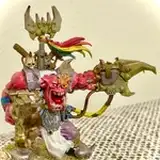
Director's Commentary: Kives, Predestination and Divine Psychology
Added 2023-08-25 12:14:54 +0000 UTCHey everyone, this is the first of the promised behind-the-scenes posts for the interim period between Lancer and Tempest. Unfortunately, finals week ran late—right into my family vacation—so this will also be the last post before Tempest drops on Saturday. Let me know if there are other topics you really wanted me to cover; I can probably slip one or two of them in while Tempest is ongoing.
In these posts, I'm going to do a brief overview of some scientific and/or philosophical ideas, and explain how I use them in Godslayers. As foretold, the first one's about Kives.
I really do mean overview: these are complicated topics with long histories and a ton of different perspectives. True understanding comes with study; this post is more aimed at introducing some ideas that I found interesting enough to use in the serial. If you want to learn more or have a deeper discussion about some of these ideas, check the links at the end or drop by the Paraphysics Research channel in the Godslayers discord.
Alright, enough preamble, let's talk oracles.
Background
There's a long history of prophecy in stories, with some of the more famous examples hailing from ancient Greece. In those stories, prophecies tend to be self-fulfilling—you hear about the bad thing, and the actions you take to avoid it end up causing it. This sometimes comes off to modern audiences like those characters were being stupid (obviously if you abandon your son to die in the wilderness, he's much more likely to kill you and marry your wife), but we're used to nitpicking fictional decisions because we live in a world where IMDB has a section for continuity errors.
Contextually, the idea being evoked was that Fate is fixed, and that we're powerless against what the universe has in store for us no matter how hard we struggle to avoid it. (I suspect modern audiences will find this idea more relatable.) In contrast, the IMDB attitude assumes that there's a specific set of actions you can take to change the future to something more desirable.
In short, part of the culture gap comes down to different stances on a philosophical question: How much do our decisions actually matter?
In this post, we're gonna break down how Kives facilitates that question in Godslayers.
The Dreaded Free Will Debate
So the first question we gotta tackle is whether we're actually the ones making our decisions.
This question is usually debated through the lens of the "free will" construct. There's a lot of definitional problems with free will, but we'll bracket those for now and stick with one of the more common ideas: "the freedom to do otherwise."
There are three positions you can take here:
The edgiest position is determinism, which argues that you don't have free will. The determinist will argue that we successfully rely on determinism in every other sphere—e.g., when we run a bunch of repetitions of a physics experiment, it's because we believe that cause and effect behave such that the same initial conditions produce the same results.
Determinism implies that when you think you're making decisions, that's actually an illusion, and that the "real" cause of those conditions is the state of your brain at the time of the decision. You may have acted the way you wanted to, but how much power do you have to want the way you want to?
This is a very uncomfortable conclusion, but the determinist would argue that the alternative is absurd: We don't believe that our thoughts and experiences happen at random; we tend to think that we think and act for reasons. Things get even more complicated when we start looking at mental disorders like phobias; or, in a less extreme case, behavioral conditioning of the sort that occurs through e.g. social media notifications. It's hard to argue that I have the ability to do otherwise when the little bu-DOOP noise on my computer triggers a subconscious reflex to alt-tab over to Discord.
The weakness of determinism is that it is a very strong claim, and seems to go against our lived experience. Practically, we assume as a matter of course that we can make meaningful choices. As such, some philosophers prefer compatibilism, which is an attempt to reconcile that experience to the epistemological concerns motivating determinism.
Classically, compatibilists argued that free will should be understood not as "the freedom to do otherwise", but "the freedom to act according to your desires," i.e. a lack of external constraint. The determinist gotcha is to pull out the "ah, but are you free to desire what you desire?" card, but the compatibilist response is that we've got more than one desire and it's not unreasonable to suppose you could have acted on any of them.
Under compatibilism, we can look at things like my conditioned response to Discord notifications and categorize them not as evidence of a fundamental lack of agency, but rather as infringements on the agency I seem to think I possess.
Finally, libertarianism (no, not that one) is the position that we do, in fact, possess nondeterministic free will. The central argument is simply that we seem to have free will and that free will doesn't seem to be determined—at least, not fully—by external conditions. Again, the determinist will argue here that this is an absurd notion, and that this would entail our behavior is fundamentally arbitrary or random, but in fact this is not necessarily the case.
Quick terminology diversion: in philosophy, you sometimes hear about "strong" vs "weak" arguments for a position. This is jargon, not a value judgment. A "strong" argument is one that, if successful, compels belief in its conclusion; someone who rejects a strong argument without good reason is being intellectually inconsistent. A "weak" argument does not compel belief in its conclusion, but rather establishes that its position is intellectually consistent. A successful weak argument for a position is sufficient to defeat a strong argument against it.
And that's pretty much all the libertarian has to do here. The determinist has leveled two strong arguments: nondeterministic free will is epistemologically inconsistent, and free will would be meaningless if nondeterministic. They only need weak arguments for both.
Going in reverse order: libertarians might say that behavior does not need to be deterministic to be meaningful. Just because I had meaningful reasons to go play Satisfactory doesn't necessarily entail I would do so 100% of the time under the same initial conditions; the determinist just assumes it does.
Empirically, we observe that human behavior tends to fall into statistical distributions. The determinist would argue that the difference in behavior is due to relevant causative differences in the initial conditions of that behavior, but if there was a nondeterministic causative element in human behavior, a statistical distribution is exactly what we'd expect to see.
On the argument about epistemological consistency, the libertarian can point out that we have an empirical example of nondeterministic systems in nature: quantum physics.
I heard you rolling your eyes. Hear me out. The pop culture understanding of "free will emerges from quantum physics!" is usually bogus, since above the quantum level everything averages out to determinism. This argument is slightly different: rather than proving that there's definitely quantum interaction with consciousness, they only have to show that it's reasonable to believe there might be some kind of nondeterministic mechanism in play.
This form of argument works because, contextually speaking, it's a response to an accusation that the libertarian position contradicts how things work everywhere else. Even one counterexample is enough to show that things don't work that way in all areas. And for some philosophers, that counterexample is quantum biology. They don't need to prove that quantum-level events influence the neurology of consciousness; they only need to show that until the empirical question is resolved, it's reasonable to believe it might resolve either way.
Again, this isn't to say "quantum physics proves free will exists!"—the argument is just that the determinists' strong argument has overplayed its hand. As such, it's not necessary to put all the eggs in the quantum physics basket as long as there's some plausible mechanism that satisfies the determinist critique that nondeterminism is an incoherent concept. We can blame emergence from neural interactivity, or some libertarians posit that souls exist and are the source of free will.
Joke's on them: in Godslayers, souls are deterministic. I mostly made that decision to troll libertarians—truly, this is the nerdiest possible instance of that sentence—but it's also partly because I decided that the metaphysics of Godslayers needed to be compatibilist for Kives to work.
The Problem of Divine Foreknowledge
An omniscient deity—or at least one who can see the future—presents a huge problem for the question of free will. We've defined free will as "the freedom to do otherwise," but if we posit some agent ∆ who knows exactly what I will do in the future, then it would seem there isn't any practical sense in which I can have the ability to do otherwise.
As a concrete example: we'll say I have six games installed on my computer, and it seems to me that I have the ability to choose to play any of them. But if Kives knows that I'm going to play Satisfactory, then that implies that, in fact, there is no possible world where I make any choice but the one I end up making.
We may object that this isn't the problem it seems to be: "By definition, you can only choose the thing you will have chosen." But this ignores the point of the original problem, which is that I believe that which thing I choose is a function of my will, rather than some kind of historical necessity.
There are various solutions to this issue, but Kives doesn't qualify for a lot of them right out of the gate due to her role in the story.
The first class of unhelpful solutions are the ones that limit foreknowledge in some way. Most of these were developed for reconciling free will with the omniscient God of Christian theology, so you get arguments that e.g. define omniscience as "possessing all knowledge it is possible to possess" and then arguing that free will makes it logically impossible to possess foreknowledge of someone's actions. I can't use this for Kives because it excludes the possibility of oracles.
The second class are solutions that attempt to preclude the reality of a definite future. We can immediately toss out the argument that foreknowledge is impossible if the future doesn't actually exist (as opposed to potentially existing); again, I need foreknowledge to be possible for this story.
One argument under this category is that the shape of the future is contingent on human choice. There's a couple ways to handle this. We could say that the oracle knows all potential futures, but human choice determines which future becomes actual. The second draft of Godslayers started out with this model, but as I continued developing the plot, I realized that Kives had access to enough information to defeat the godslayers the moment they landed on Theria. So we had to ditch that.
The weaker version of this model is that the oracle only knows the current state of the future, and that the future changes every time someone makes a decision. From a fiction-writing perspective, this opens up some problematic issues.
First, under this model, there are still ways to exploit foreknowledge that are nearly as broken as knowing every potential future. The ratfic (rational fiction) community is full of examples of this; since Godslayers was originally intended for a ratfic audience, taking this route would either lock me into writing about time loop shenanigans, or turn away a bunch of my potential audience when they got frustrated about characters not using the most powerful tools available to them at all times.
Second, if the future can change, then oracles can't reliably know the future. Given that the deicide teams are ludicrously overpowered, Kives becomes a much weaker opponent in this case. The story would be boring if she got steamrolled.
That narrows it down to solution classes where there's exactly one future, and that future doesn't change (i.e. the metaphysics aren't libertarian). Conveniently, as the author, I already have access to that information. Instead of working out multidimensional contingency graphs, I can just have Kives react to the actual plot.
As for whether the metaphysics is deterministic or compatibilist: you may have noticed that the lines blur depending on how you define "free will." Rather than resolve the ambiguity, I used it for characterization.
Kives OP rito pls nerf
The problem with a character who knows the script is that it's nearly impossible to defeat them. This is especially problematic for the main antagonist of a million-word web serial—if it feels impossible to win, it deflates tension and burns people out. So I had to come up with ways to make it possible (or at least seem possible :P) for the godslayers to scrape out a win.
As it turns out, there's already a rich intellectual tradition of explaining why the gods can't do everything perfectly, so most of the work defining the problem was already done for me. I'm talking, of course, about the Problem of Evil.
Briefly stated, the PoE is as follows: the Christian theological tradition defines God as being omniscient, omnipotent, and omnibenevolent—that is, God knows everything, can do anything, and is perfectly moral. We take that as our major premise, then add a minor premise: a good agent eliminates or prevents evil insofar as they are able to. Therefore, if God exists, then evil does not exist. However, evil exists. Therefore, God must not exist.
The PoE seems to put the theist in a position where they must reject one of the three omnis:
- Not omniscient: God has the power and will to eliminate evil, but doesn't notice it for some reason
- Not omnipotent: God knows about evil and wants to eliminate it, but lacks the ability to do so
- Not omnibenevolent: God knows about evil and could eliminate it, but doesn't care enough
There's a fourth option where you reject the premise that a good person must eliminate evil insofar as they are able; e.g. Alvin Plantinga, a Christian philosopher, argued that an omnibenevolent God might allow lesser evils to exist in order to allow for higher-order goods. For example, when a doctor cuts off a gangrenous limb, it's the infliction of a lesser harm (loss of the limb) to secure a higher good (the patient's life). While logically consistent, it's not without counterarguments (e.g. if there are second-order goods, doesn't that just kick the PoE back to second-order evils?). It's also not a satisfying answer to the existential question that usually motivates PoE discourse: Why did God allow evil to happen to me?
(On that existential question, I highly recommend Dostoevsky's portrayal of it in The Brothers Karamazov, "Rebellion")
Bringing us back on track, we can vaguely organize Kives's limitations along the lines of the Problem of Evil by substituting a new minor premise: "Why doesn't Kives just get whatever she wants?"
Omniscience: the streetlight problem
There's a parable among empiricists where some dude's trying to find his keys; it's night, but there's a streetlight. A helpful stranger offers to assist. After half an hour, the stranger asks, "are you sure this is where you lost them?"
"No," says the dude, pointing out into the darkness. "I lost them over there."
"What?! Then why are you looking here?"
The dude shrugs helplessly. "It's where the light is."
Early drafts of Godslayers struggled a bunch with how much information the gods were allowed to have. In the draft before this one, they were more aware of significant events, with significance being a function of the consequences of those events.
Everything the godslayers did was hugely important because their mission affected the entire planet—so much so that they had to carefully calculate each action they took, to avoid empowering the gods those actions harmonized with. In that draft, Lilith didn't have a cloak—instead, her soul augment prevented her actions from having any etheric significance, meaning she could do whatever she wanted while the rest of the team had to watch their behavior. (Yes, it was a depression metaphor instead of a dissociation metaphor.)
That all ended up being way too much bookkeeping. I was also running into a separate problem: by that point, I'd decided that etherspace was timeless, so every etheric entity existed across the timeline. That meant every god was functionally Kives. No one's good enough to pull that off (with the possible exception of Sam Hughes).
So I decided to dial everything way back by reducing what the gods could "see," in the vein of the streetlamp parable. In this new system, the gods both think and interact with realspace in terms of their aspects. That let me ditch the previous significance system and just make events significant based on how deeply they embody the god's aspect. So if you run a race, Kabiades might vaguely be aware it's happening; if you run super hard in the Olympics, he's probably paying close attention.
The new system is great for legibility, because the reader can parse which gods are going to be involved based on the actual semiotic implications of the text. That also lets me keep the gods alinear without any bookkeeping at all—for example, toward the end of Lancer, Alcebios starts showing up before they kill a bunch of whispers and Kabiades, because there's a lot of murder involved and that's something she pays attention to.
But under this new system, Kives's aspect was still about cause-and-effect and came with all the same bookkeeping issues. There's also the issue where everything is part of cause and effect, so getting stuck at prog monophase was a plot hole—she should have immediately blown herself up to triphase and died.
My solution was the invention of "etheric dyads," which is sci fi jargon for a common IRL superstition. As a rule, paraphysics jargon is a three-step process:
1. Take a subjective human experience.
2. Posit that it's objectively real on another plane of existence (etherspace).
3. Use math and science words to evoke the kind of paraphysics thing it would be.
In this case, the experience I stole looks like "this random thing happened to me, and then this other significant thing happened as a direct result!" It's often called "things happen for a reason," or in Christian circles, "things happening according to God's plan." That second one was great for the story because Lilith certainly heard that phrase a lot growing up, and I knew Kives doing that all the time would seriously piss her off.
Real life example of an etheric dyad: a mental health worker once told me that he was supposed to go to a concert, but his car broke down the day of. He decided to use the day to do some chores instead, and while walking to the grocery store, he ran into a homeless woman in crisis. Through the event, he reflected that if his car hadn't broken down, she might not have gotten help; the car trouble took on new significance in light of its consequences. If paraphysics were real, that significance would exist as some kind of etheric connection between the two events.
So introducing "dyadic entanglement" gave me something concrete I could use for Kives: instead of being the goddess of things causing other things, she could be the goddess of things that happen for a reason. The fact that her husband Horcutio was already the god of pointless bad luck made it perfect.
That gives us:
Kives Rule 1: Kives can only observe events connected by etheric dyads, and she can only interact with the world through dyadic events.
The rule is broad enough to give Kives a lot of options, and specific enough that the team can attempt to maneuver around her—or at least get a decent idea of what information she has on them. It doesn't cover her growth/fertility aspect, but we'll get into that in a moment.
That leaves just one issue: No one wants to read a story where the main characters' best chance of success is doing things for no reason at all. I wanted to keep the idea that Eifni could beat oracles with randomness, but actually writing it was a pain.
My compromise, which emerged from some unrelated mid/late-game plotting, was to give Kives the Mantle—that dome around the planet that enhances her oracular abilities. Having a Kives-specific buff meant that Eifni got to keep their narratively unsatisfying SOP without ruining my story with it. It was also narratively useful to shape the serial's overarching conflict as the godslayers aim toward bringing it down.
Omnipotence: Can Kives create a situation so funny she can't keep a straight face?
Kives was never omnipotent, but a lot of people enter the oracle conversation as though knowledge is a one-to-one correspondence with power. This is not, in fact, the case: we can trivially disprove this argument with the example of someone who's watching an out-of-control trolley bear down on them, but lacks the ability to get out of the way in time.
Functionally, however, this is the lens that a lot of people will bring to a story about an alinear agent acting on information about the future.
You've probably already heard the most famous challenge to the idea of omnipotence: "Can God create a rock so heavy he can't lift it?" It's the pithiest of a class of arguments attempting to prove there are limits on God's ability to act, i.e. that God is not omnipotent.
Some apologists have responded to this objection by defining omnipotence as "possessing power inasmuch as power is able to be had"; that is, certain things simply cannot be done, and therefore God not being able to do them doesn't invalidate God's omnipotence. Under this argument, "a rock so heavy God can't lift it" is just as much a logical impossibility as a four-sided triangle or a married bachelor; God can't create those either, not due to God's limitations, but because it is not logically possible to create them.
What are the logical constraints on Kives's actions? We can get two rules this time:
Kives Rule 2: Just because Kives knows something could happen, doesn't mean she necessarily has the ability to avert it.
Kives Rule 3: If Kives has multiple goals, two or more of them might require mutually exclusive actions to achieve.
Using an example from Book 2: At one point, Lilith believes that Kives has compromised her because she took action to hide her support of Roel from the team. Let's suppose that such a situation can only occur if Roel is injured in a way that makes Lilith feel terrible, but Lilith's character is such that her guilt will drive her away from giving the emotional support that Roel needs. If Lilith is correct that Kives engineered that situation, that means Kives had to also accept the penalty of ruining Lilith's and Roel's relationship: there was no outcome where Kives achieved the Roel moment and also kept that relationship intact.
Let's make things a little more concrete. Under which conditions does Kives encounter these constraints?
This is the point where we go back to her aspects. Kives is primarily a goddess of growth; her oracular aspect isn't an independent aspect yet. That means the areas where she'll have the most influence are the ones that play into that main aspect. In Godslayers, "growth" encompasses the usual plants-and-babies stuff you'd expect from a fertility goddess, but it also includes personal growth. Which gives us the final rule for this section:
Kives Rule 4: Kives can't act unless it's directly tied to a character experiencing personal development.
You can think of this as a resource economy where every life lesson someone learns is another metacausal bullet in Kives's chamber. There's more to that idea, but let's fill out the context first.
Omnibenevolence: "The quintessence of a concept given agency"
What does it actually mean to be omnibenevolent? We might say that an omnibenevolent god is "morally perfect," but then we need to ask what it means to be moral. And that's actually a tricky question.
GEM Anscombe argues in "Modern Moral Philosophy" that the modern conception of morality, with its reliance on moral obligations, is incoherent. This isn't just some argument—the paper is considered an important landmark in philosophy of ethics, and it raises some troubling points. (As well as some incredible zingers; I wouldn't want to run into her in a dark rhetorical alley.)
Anscombe points out the word "morality" comes to us from Aristotle, but the way it's used in Aristotle doesn't match the way we use it today. Aristotle speaks of "moral virtues" and "intellectual virtues" in the same breath, and the sense of morality being a kind of external law imposed on us is absent in his writings.
That sense, Anscombe says—that is, that morality is some kind of law that compels us to act in particular ways—comes to us via Christianity, which posited a divine lawgiver and thus a context in which it made sense to use the language of a courtroom for moral questions. Western philosophy eventually moved on, but we've retained what Anscombe calls the "mesmeric force" of words like "ought" despite having abandoned the ontology that gave them that force.
Anscombe's proposed solution is to eliminate the standalone terms "good" and "bad" and instead replace them with the more specific "good/bad with respect to some goal." That's a lot more manageable for our purposes; we can use it to relativize good and evil to the aspects of each god. It also has some interesting implications for divine psychology in the setting.
Implication one, a god's value system is exactly identical to the aspects that power them. That makes them a kind of maximizer—whatever concept they represent, they want more of it. Maximizer agents are a fantastic opportunity for characters making incomprehensible alien decisions, so I was happy about this one. The trick isn't what the maximizer cares about, it's all the weird non-intuitive things they don't care about that you feel like they should. For example:
Implication two, gods don't inherently care about self-preservation. Val calls them "the quintessence of a concept given agency"—in other words, they're the purest possible version of whatever idea they embody, and that's what drives their decision-making. That means that e.g. Kabiades interacts with the world purely through the modality of athleticism; any consideration he gives to self-preservation is through the lens of how it affects the overall prevalence of athleticism in the environment.
As a reminder, a god's persona is a mechanism that converts unrelated frequencies into something that matches their aspects; "Kabiades" cares if you're gay because it's set up to convert sexism into athleticism, but "Bunsin" probably doesn't. Actually, you know what? I'm just gonna Word of God that Bunsinites are super queer-friendly. This setting is horrible enough.
We can derive a third implication from those two: all gods will attempt to hit triphase even though they'll probably die in the process. Everything they do is to maximize their aspects; maximizing their aspects causes them to develop more aspects; their ability to consider not doing that is directly tied to whether it helps them maximize their aspects. "Okay but what if they held off until they could do it properly" there's no time in etherspace, remember? No time means no such thing as delayed gratification.
Anyway, going back to Kives, this gives us our last rule:
Kives Rule 5: Kives doesn't interpret her conflict with the godslayers through the lens of conflict—she's just taking the actions that maximize growth and things-happening-for-a-reason.
Whereas the other rules were more aimed at defining how Kives acts, this one defines the why. That's important because it lets the godslayers find ways to play Kives against herself—for example, Val's monologue at the end of Lancer.
This raises one apparent problem: if Kives isn't in conflict with the godslayers, why does her behavior look so much like conflict? Also, Eifni is a very scientific bunch; wouldn't they have noticed that gods are pursuing their value systems rather than directly fighting them?
The answer has two parts. First, deicide operations usually entail a lethal challenge to the god's value system—most of their strategies boil down to "deliver large anti-semiotic charge to target." As covered above, that is something a god will fight you over—for maximizer reasons, not self-preservation reasons. The exception here is the strategy where they accelerate an unstable god to triphase and let it implode; as established, gods don't fight back on that one.
Second, you might have noticed that Velean culture views pretty much everything through the lens of conflict. "Go for the throat" and all that. It seems to work out for them.
Bonus Round: Sending Angels to the Pilgrim Ship
Now that we've exhaustively explained the theory behind Kives, let's use the battle at the pilgrim ship (from the end of Planetfall) to illustrate how everything works in practice.
To set the scene: the godslayers have decided to engage a bunch of pirates so they can harvest the souls of their sea-beast mounts and repair the Ragnar. They can expect Kives to know about the repair attempt, as it's a direct consequence of Kives damaging their ship in the initial ambush—Rule 1, Kives gets information through etheric dyads.
The team has seen an ambush from Kives; she also sent an angel after them right after they learned Kivian theology calls them the "Calamity." They have every reason to suspect that she'll respond with more military force—however, Val also knows the equations that govern her behavior. That allows him to calculate her response to any sufficiently-defined situation, and he uses that to construct a situation where Kives's goals line up with the team's goals (Rule 5: Kives ultimately just wants maximum growth).
In this case, what Kives wants is to prevent a mass-casualty event among her followers so they can promote her values later. That effort takes a couple forms.
First, while the godslayers are recruiting pilgrims for the doomed voyage, Kives manages to prevent most of them from getting on the ship. To the godslayers, this looks like a string of insultingly random coincidences, but it's actually Rule 1 (Kives acts through dyads). In some cases it's also Rule 4 (Kives needs someone to experience personal development before she can act).
In a couple cases, we hear that Kives has given a message to her temples: a general warning not to do a pilgrimage, and at least one specific warning that the warden of the local prison shouldn't release anyone. These are actually Rule 4 cases as well; we later find out that Kives is constantly trolling her priestesses into experiencing growth moments.
But Kives isn't able to prevent every potential target from making it onto the ship (Rule 2). She's also given up the information that a confrontation with the pirates is most likely going to happen, which would be a concern for a Velean, but Kives doesn't care about it unless it affects personal development (Rule 5).
The team takes advantage of this by positioning Val with a sniper rifle, a moirascope, and orders to shoot anyone approaching the ship with an etheric entanglement. Due to complicated alinearity shenanigans—which I'm not getting into, that's definitely a subject for another post—this prevents Kives from causing any last-minute annoyances. The basic idea is they're exploiting a logical constraint: once Kives reveals that the pirate battle is going to happen, the godslayers know that she can't stop the ship from leaving, so the combination of Kives's goals and Val's sniper rifle metacausally prevents anyone from trying. You'll just have to trust me that it works.
With all that out of the way, it's time for the pirate battle. Val is mathematically certain that Kives will deploy angels—what's going on there?
Once again, the godslayers are exploiting logical constraints against Kives. Their mission is ostensibly against Kives's values. There's a limit to how much she can accomplish with the power of hilarious contrivances alone, so once Val determines that the operation exceeds that threshold—as well as adjusting for persona factors and previously observed behavior—he knows that Kives has to pull out the big guns.
Having established the battle is going to be Eifni vs Kives, the team exploits Rule 3: Kives can't achieve mutually exclusive goals. They do this by making things very complicated:
- Step one, they explicitly goad demigod Kulades into attacking the pilgrims in spite of Kives's protection, which he does in the name of Horcutio.
- Step two, they kill Kulades in the name of Kives.
This means the battle isn't just Eifni vs. Kives anymore; now it's also Kives vs. Horcutio. Rule 3 is now in play: Kives can either beat Horcutio's pirates or beat Eifni by not beating Horcutio's pirates—which requires sacrificing her pilgrims.
Kives, of course, acts in accordance with her values: she saves the pilgrims, summons angels to drive off the godslayers, and sets up some consequences for down the road.
Which consequences? I have great news: you'll find out when Tempest starts tomorrow!
Citations:
Since my memory of philosophy 101 is entirely unreliable for details, I relied heavily on the Stanford Encyclopedia of Philosophy for the section on free will: https://plato.stanford.edu/entries/freewill/
I also recommend this article about causality by GEM Anscombe, purely on the basis that Anscombe wrote it and she's my favorite philosopher: https://iweb.langara.ca/rjohns/files/2016/09/anscombe_causality.pdf
Comments
That's a reasonable inference! And alinearity is a fun topic, I've put it on the list!
St Trollmore
2023-09-06 05:29:20 +0000 UTCThis was very useful for clarifying my worries about whether Kives was logically consistent or not! If you're going to do follow ups, I'd love some more info on the consequences of etherspace being atemporal, and what it *means* that the gods aren't experiencing things "in a particular order"? Also, is the implication here that the reason Kives is still fighting them, even if she "knows" that her death is inevitable, (by the arriving fleet, if nothing else), is because she isn't *trying* to 'survive', but to maximise growth opportunities, and if she just gave up and let herself die quickly, less growth opportunities would have happened (while she's still alive and can experience that maximisation?)
Lucy Severine
2023-08-27 23:16:52 +0000 UTC